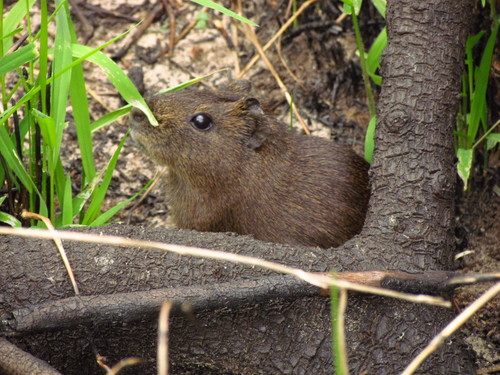


Greater Guinea Pig
cavia magna
The Greater Guinea Pig (Cavia magna) is a surprisingly large wild relative of the common domestic guinea pig, native to the wet coastal regions of South America. Unlike its dry-land cousins, this robust rodent has adapted to a semi-aquatic lifestyle, making its home in marshes, swamps, and wet grasslands. It is highly social and active, navigating dense wetland vegetation with surprising agility.
Hábitat: Typically found in freshwater marshes, wet grasslands, and swampy areas with dense vegetative cover.
The Greater Guinea Pig is a stout, tailless rodent, noticeably larger than other wild cavies, with a body length of up to 40 centimeters. It features a coarse, dense coat of dark agouti fur, blending brown and black tones that provide excellent camouflage in muddy marsh environments. It has a blunt snout, small ears, and strong, dark-clawed feet designed to traverse wet, slippery substrates.
Categoría
MamíferosRareza
Common
Peligro
1/5 · Muy bajo
Snaps
¡Sé la primera persona en hacer un snap!
Because they live in nutrient-dense wetland ecosystems, their diet consists of water-rich plants, meaning they rarely need to drink freestanding water.
Greater Guinea Pigs are highly skilled swimmers, a trait which sets them far apart from domestic guinea pigs that fear water.
To avoid being seen by aerial predators, they maintain very specific, covered runways underneath the dense marsh reeds.
It is an accomplished swimmer, utilizing its strong legs and streamlined body to cross waterways and evade terrestrial predators.
It clips and tramples dense marsh grasses to create a network of hidden tunnels or 'runways' for rapid, covert movement.
Mothers give birth to highly developed young that are fully furred, have their eyes open, and can eat solid food within hours.
Feeds on a variety of wetland vegetation, primarily consuming semi-aquatic grasses, sedges, and tender shoots.
Cerdocyon thous
The Crab-eating Fox is a primary predator of the Greater Guinea Pig, hunting them in the thick, swampy grass.
Caracara plancus
The Southern Caracara is a bird of prey that opportunistically targets young or exposed Greater Guinea Pigs from above.
Cavia aperea
The Brazilian Guinea Pig overlaps in parts of its range and competes with the Greater Guinea Pig for herbaceous food resources.
Aún no hay insignias de rasgos asignadas a este objeto.
Todavía no hay alias listados.
Las colecciones para este objeto aparecerán aquí a medida que se añadan más temas.
Peligro
1/5 · Muy bajo
Todavía no hay notas especiales de seguridad.
La forma más fácil de identificar a Greater Guinea Pig es usar la aplicación de identificación de naturaleza Snappit.
Feeds on a variety of wetland vegetation, primarily consuming semi-aquatic grasses, sedges, and tender shoots.
Typically found in freshwater marshes, wet grasslands, and swampy areas with dense vegetative cover.
Grazing
Acércate para separar los grupos y explorar dónde se ha fotografiado este objeto.
Los snaps recientes aparecerán aquí a medida que se añadan nuevas observaciones.



















