

Green Falsejingle
pododesmus macrochisma
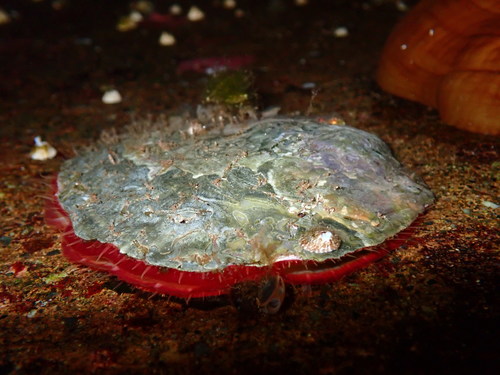
The Green Falsejingle (Pododesmus macrochisma) is an intriguing marine bivalve mollusk belonging to the family Anomiidae, commonly known as jingle shells. Found anchored to hard surfaces along the cold coastal waters of the North Pacific, this resilient species is famous for its highly irregular, translucent, and pearly shells. What makes the Green Falsejingle particularly fascinating is its physical adaptation to its rocky environment: it permanently cements itself to substrates using a calcified byssus plug that protrudes through a specialized hole in its lower shell valve. Over time, its upper shell grows to match the exact contours of the rock it rests upon, making it a master of structural conformity.
Hábitat: Inhabits low intertidal to subtidal rocky shores, permanently cemented to hard substrates like reefs, stones, and dock pilings.
This bivalve features an irregular, circular-to-oval shell reaching up to 10 cm in diameter, with a highly distorted, rough outer surface that mimics surrounding rocks. The upper valve is typically a dull gray, brown, or pale green on the exterior, often covered in algae or bryozoans. However, the interior of the shell is spectacular, showcasing a brilliant, iridescent pearly-green to blue-green luster. The flat lower valve, which is typically smaller and thinner, contains a highly distinctive, large pearly-bordered hole near the hinge where the securing plug emerges.
Categoría
InvertebrateRareza
Common
Peligro
1/5 · Muy bajo
Snaps
¡Sé la primera persona en hacer un snap!
Its stunning, pearly green interior color comes from a combination of organic pigments and the physical structure of the nacre, which reflects light.
Known as 'jingle shells' because a handful of empty shells clink together with a metallic, bell-like sound.
Native peoples once used the shiny, translucent shells of related jingle shell species as natural wind chimes and decorative ornaments.
The lower shell has an actual hole through which a calcified byssus plug emerges, gluing the animal permanently to a rock so tightly that the shell conforms to the rock's shape.
Secures itself to rocks by producing a liquid secretion that hardens into a solid, bone-like calcified plug through a hole in its lower shell.
Sparsely molds the growth of its upper shell to match the exact surface texture and curves of the substrate below it for reduced drag.
Deposits thick layers of iridescent nacre on its inner shell surface to reinforce structural integrity against crashing waves.
A suspension feeder that filters seawater to extract phytoplankton, diatoms, and organic detritus.
Diferencias por edad: Larvae are free-swimming planktotrophic veligers feeding on microalgae, while adults are sessile filter feeders.
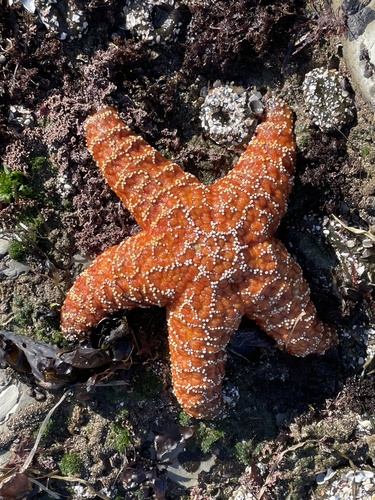
Pisaster ochraceus
Preyed upon by sea stars which can pry apart or dissolve the shell.
Enteroctopus dofleini
Octopuses use their radula and beak to drill into and consume the bivalve.
Nereocystis luetkeana
Both species attach to rocky reefs, occasionally competing for attachment space in high-energy zones.
Aún no hay insignias de rasgos asignadas a este objeto.
Todavía no hay alias listados.
Las colecciones para este objeto aparecerán aquí a medida que se añadan más temas.
Peligro
1/5 · Muy bajo
Todavía no hay notas especiales de seguridad.
La forma más fácil de identificar a Green Falsejingle es usar la aplicación de identificación de naturaleza Snappit.
5-10 cm
0.05-0.2 kg
3-10 años
A suspension feeder that filters seawater to extract phytoplankton, diatoms, and organic detritus.
Inhabits low intertidal to subtidal rocky shores, permanently cemented to hard substrates like reefs, stones, and dock pilings.
Filtering
10000-100000
Acércate para separar los grupos y explorar dónde se ha fotografiado este objeto.
Los snaps recientes aparecerán aquí a medida que se añadan nuevas observaciones.