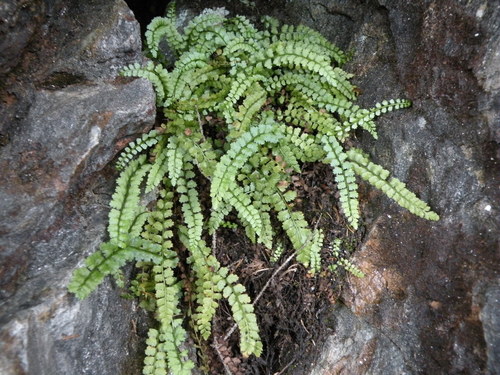


Green Spleenwort
asplenium viride
The Green Spleenwort is a delicate, small, evergreen fern that thrives in the cool, damp microclimates of alpine and subalpine regions. Unlike many of its hardier relatives, this species has a strong preference for calcium-rich substrates, making it an excellent indicator of limestone or other alkaline rock formations. It forms neat, bright green tufts that peer out from rocky fissures, adding a touch of vibrant life to harsh, stony cliffsides.
Hábitat: Typically found growing in moist, shaded crevices of calcareous or alkaline rocks, such as limestone, in montane and subalpine environments.
This small fern features delicate fronds that typically grow between 5 and 15 centimeters in length. The key identifying feature is its bright green stalk (stipe and rachis) which remains green throughout its entire length, distinguishing it from other spleenworts with dark brown or black stalks. The fronds are once-pinnate, bearing small, oval to round leaflets (pinnae) with gently scalloped or toothed margins arranged alternately along the central stem.
Categoría
PlantasRareza
Common
Peligro
1/5 · Muy bajo
Snaps
¡Sé la primera persona en hacer un snap!
Because it strictly requires calcium-rich environments, finding this fern is a reliable indicator that the surrounding rock is limestone or dolomite.
Its microscopic spores are light enough to be carried by wind currents for hundreds of miles, allowing it to colonize isolated mountain ranges.
The species name 'viride' is Latin for 'green', referencing the bright green stem that distinguishes it from its dark-stemmed relatives.
It utilizes highly specialized, fibrous rhizomes that can penetrate and grip microscopic fissures in solid rock faces to secure anchorage and absorb moisture.
It possesses physiological adaptations that allow it to absorb nutrients efficiently in highly basic, calcium-rich soils that would stunt other plant species.
During dry spells, the fronds can curl and reduce metabolic activity, quickly rehydrating and recovering when moisture returns.
As a photosynthetic autotroph, it produces its own energy using sunlight, water, and carbon dioxide, supplemented by minerals absorbed from damp rock crevices.
Asplenium trichomanes
Competes for limited space and resources in alkaline rocky crevices.
Deroceras reticulatum
Feeds on the delicate young fronds of the fern in damp microclimates.
Aún no hay insignias de rasgos asignadas a este objeto.
Todavía no hay alias listados.
Las colecciones para este objeto aparecerán aquí a medida que se añadan más temas.
Peligro
1/5 · Muy bajo
Todavía no hay notas especiales de seguridad.
La forma más fácil de identificar a Green Spleenwort es usar la aplicación de identificación de naturaleza Snappit.
5-15 cm
5-15 años
As a photosynthetic autotroph, it produces its own energy using sunlight, water, and carbon dioxide, supplemented by minerals absorbed from damp rock crevices.
Typically found growing in moist, shaded crevices of calcareous or alkaline rocks, such as limestone, in montane and subalpine environments.
Photosynthesis
Acércate para separar los grupos y explorar dónde se ha fotografiado este objeto.
Los snaps recientes aparecerán aquí a medida que se añadan nuevas observaciones.