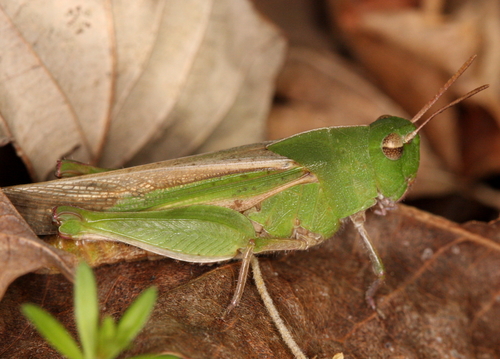


Green-Striped Grasshopper
chortophaga viridifasciata
The Green-Striped Grasshopper is a fascinating orthopteran widely distributed across North America. Often among the very first grasshoppers to emerge in the spring, it overwinters as a late-stage nymph rather than an egg, giving it a major head start as soon as temperatures begin to rise. This species exhibits striking sexual dimorphism and color polymorphism, making it a highly variable and intriguing subject for nature spotters.
Hábitat: Typically found in sunny, open areas with short grass, such as pastures, fields, roadsides, and suburban lawns.
This medium-sized grasshopper ranges from 2 to 4 cm in length, with females being significantly larger than males. They display a distinct high ridge on the pronotum (the shield behind the head) cut by a single small notch. Coloration is highly polymorphic: females are typically bright green with a brown stripe on each forewing, while males are mostly brown with pale markings. In flight, their hind wings reveal a clear to pale-yellow base with a smoky dark band along the outer margin, spanning 4 to 7 cm.
Categoría
InsectosRareza
Common
Peligro
1/5 · Muy bajo
Snaps
¡Sé la primera persona en hacer un snap!
The crackling sound they make in flight is called crepitation and is produced by the snapping of their wings, not by rubbing their legs together.
The green-striped grasshopper is often the very first grasshopper you will see in the spring, sometimes emerging while there is still snow on the ground.
Their color is highly influenced by temperature and humidity during development; cooler, wetter conditions tend to produce more green individuals, while dry conditions yield brown ones.
Males can produce a loud, dry crackling sound during flight by snapping their hind wings together, which is used for territory defense and mate attraction.
Their coloration is influenced by environmental moisture and temperature during development, allowing them to match the surrounding green spring foliage or dry summer grasses.
They survive freezing winter temperatures as active nymphs rather than eggs, allowing them to become active on warm winter days and emerge early in spring.
Feeds almost exclusively on various grasses and herbaceous plants, preferring succulent green leaves and tender shoots.
Diferencias por edad: Nymphs and adults consume similar plant matter, though younger nymphs prefer softer, tender young shoots.
Falco sparverius
Serves as a major prey item during the spring and summer breeding seasons.
Poa pratensis
Feeds primarily on this widespread grass species.
Tenodera sinensis
An opportunistic insect predator that hunts grasshoppers in grassy fields.
Aún no hay insignias de rasgos asignadas a este objeto.
Todavía no hay alias listados.
Las colecciones para este objeto aparecerán aquí a medida que se añadan más temas.
Peligro
1/5 · Muy bajo
Todavía no hay notas especiales de seguridad.
La forma más fácil de identificar a Green-Striped Grasshopper es usar la aplicación de identificación de naturaleza Snappit.
Feeds almost exclusively on various grasses and herbaceous plants, preferring succulent green leaves and tender shoots.
Typically found in sunny, open areas with short grass, such as pastures, fields, roadsides, and suburban lawns.
Grazing
20+
15+ días
Acércate para separar los grupos y explorar dónde se ha fotografiado este objeto.
Los snaps recientes aparecerán aquí a medida que se añadan nuevas observaciones.















