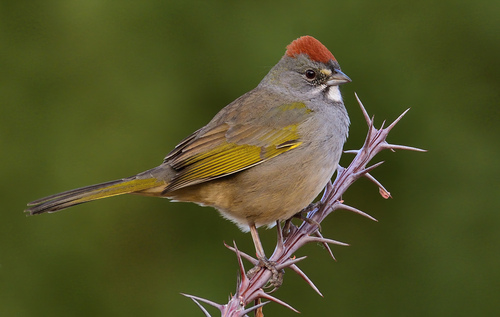


Green-Tailed Towhee
pipilo chlorurus
The Green-Tailed Towhee is a handsome, secretive sparrow of the American West. Although it belongs to the towhee family, it is the smallest of its kind, distinguished by its vibrant olive-green highlights and a bright rufous crest. This ground-dwelling songbird is notorious for its skulking behavior, spending much of its time darting under dense mountain brush and chaparral where it searches for seeds and insects. When it does emerge, it often climbs to the tip of a sagebrush or scrub oak to deliver a sweet, complex, and buzzy song that carries beautifully across its mountainous home.
Hábitat: Found in montane chaparral, dense sagebrush, and arid brushy slopes of the western United States and Mexico.
This medium-sized sparrow-like bird measures between 18 and 21 centimeters in length with a wingspan of roughly 24 to 28 centimeters. It is easily identified by its bright rufous-chestnut cap, a crisp white throat patch bordered by dark mustachial stripes, and a clean grey breast. True to its name, its long tail and the outer edges of its wing feathers are a conspicuous olive-green. The bill is dark and conical, perfectly adapted for cracking seeds, and the legs are a pale pinkish-grey.
Categoría
AvesRareza
Common
Peligro
1/5 · Muy bajo
Snaps
¡Sé la primera persona en hacer un snap!
Despite its bright rufous cap and green highlights, the Green-Tailed Towhee is the smallest of all North American towhee species.
During the breeding season, males will defend territories of up to 1.5 hectares, using the highest twigs of sagebrush as singing posts.
Their common call note is a buzzy, nasal 'mew' that sounds incredibly like a lost kitten calling from the bushes.
Utilizes a rapid, synchronized backward jump to kick away leaf litter with both feet simultaneously, exposing hidden insects and seeds.
Sings from deep inside dense shrubs with muffled tones that make it incredibly difficult for predators to pinpoint its exact location.
Possesses short, rounded wings and strong legs that allow it to navigate thick, tangled underbrush with remarkable speed and silence.
Feeds primarily on a mix of seeds and small insects found in ground litter, shifting to a high-protein insect diet during the spring and summer breeding seasons.
Molothrus ater
Hosts the parasitic eggs of this species, which can reduce the nesting success of the towhee.
Accipiter striatus
Frequently preys upon nesting adults, fledglings, and eggs within the dense chaparral canopy.
Artemisia tridentata
Relies heavily on this shrub for nesting cover, shelter, and foraging grounds.
Aún no hay insignias de rasgos asignadas a este objeto.
Todavía no hay alias listados.
Las colecciones para este objeto aparecerán aquí a medida que se añadan más temas.
Peligro
1/5 · Muy bajo
Todavía no hay notas especiales de seguridad.
La forma más fácil de identificar a Green-Tailed Towhee es usar la aplicación de identificación de naturaleza Snappit.
18+ cm
24+ cm
0.024+ kg
3+ años
25 km/h
Feeds primarily on a mix of seeds and small insects found in ground litter, shifting to a high-protein insect diet during the spring and summer breeding seasons.
Found in montane chaparral, dense sagebrush, and arid brushy slopes of the western United States and Mexico.
Acércate para separar los grupos y explorar dónde se ha fotografiado este objeto.
Los snaps recientes aparecerán aquí a medida que se añadan nuevas observaciones.

Colorado, US
Puedes ver Great Basin Bristlecone Pine y Ciervo Mulo.
Ver guía →

Colorado, US
Puedes ver Great Basin Bristlecone Pine, Black Rosy-Finch y Zorro Rojo.
Ver guía →









