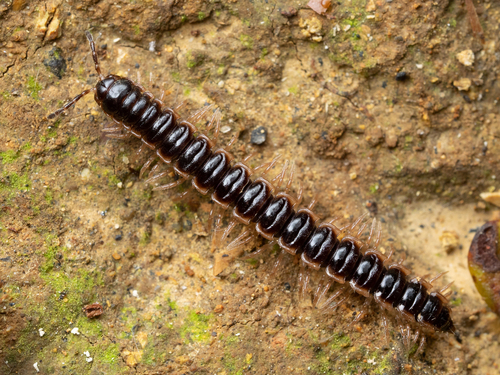


Greenhouse Millipede
oxidus gracilis
The Greenhouse Millipede (Oxidus gracilis), also known as the hothouse millipede, is a small, highly successful arthropod that has spread from its native Asian range to greenhouses, gardens, and urban environments worldwide. Primarily active in damp, dark microhabitats, this species plays an essential ecological role as a detritivore. By consuming decaying organic matter, leaf litter, and compost, it accelerates the decomposition process, returning vital nutrients back into the soil. Though often considered a minor pest when they aggregate in large numbers inside greenhouses or damp basements, greenhouse millipedes are completely harmless to humans and pets, lacking any bite or sting. Instead, they rely on chemical defenses and their cryptic lifestyle to survive, making them fascinating, ancient recyclers of the soil.
Hábitat: Typically found in moist soil, leaf litter, compost piles, and under rocks or rotting wood in greenhouses, gardens, and urban landscapes.
The Greenhouse Millipede is a small, elongated arthropod measuring between 1.5 and 2.5 cm in length, with a distinctively segmented, deep brown to almost black body. Its sides are marked by cream or pale yellow-colored keels on each segment, giving it a somewhat bumpy or textured appearance along its lateral margins. Like all polydesmid millipedes, it has a noticeably flattened body shape compared to cylindrical species, and it lacks eyes, relying instead on its antennae to navigate. Each of its double-legged body segments features pale, yellowish-white legs that move in a smooth, wave-like coordination.
Categoría
AnimalRareza
Common
Peligro
1/5 · Muy bajo
Snaps
¡Sé la primera persona en hacer un snap!
Despite their common name 'millipede' (meaning ten thousand legs), the greenhouse millipede only has around 30 to 31 pairs of legs, totaling about 60 to 62 legs.
Greenhouse millipedes are completely blind; they navigate their dark underground world entirely using their sensitive antennae and touch receptors.
When alarmed, they emit an odor resembling marzipan or almonds, which is caused by defensive secretions of hydrogen cyanide gas.
When threatened, the greenhouse millipede secretes a defensive fluid containing hydrogen cyanide, which deters predators with its toxic properties and distinct almond-like odor.
Utilizes highly coordinated, wave-like movements of its dozens of legs to push through tightly packed soil and leaf litter with efficient leverage.
Exhibits highly sensitive hygroreceptors on its antennae to locate and stay within highly humid microclimates, preventing rapid desiccation.
Feeds almost exclusively on decomposing plant material, rotting wood, and fungal mycelium, breaking down complex organic compounds into nutrient-rich soil.
Anaxyrus americanus
The toad opportunistically feeds on small millipedes when searching the forest floor or gardens at night.
Carabus nemoralis
An active predator of soil invertebrates, this beetle frequently hunts greenhouse millipedes in gardens and parks.
Aún no hay insignias de rasgos asignadas a este objeto.
Todavía no hay alias listados.
Las colecciones para este objeto aparecerán aquí a medida que se añadan más temas.
Peligro
1/5 · Muy bajo
Todavía no hay notas especiales de seguridad.
La forma más fácil de identificar a Greenhouse Millipede es usar la aplicación de identificación de naturaleza Snappit.
1+ cm
0.0001+ kg
1+ años
Feeds almost exclusively on decomposing plant material, rotting wood, and fungal mycelium, breaking down complex organic compounds into nutrient-rich soil.
Typically found in moist soil, leaf litter, compost piles, and under rocks or rotting wood in greenhouses, gardens, and urban landscapes.
Foraging
40+
Acércate para separar los grupos y explorar dónde se ha fotografiado este objeto.
Los snaps recientes aparecerán aquí a medida que se añadan nuevas observaciones.



