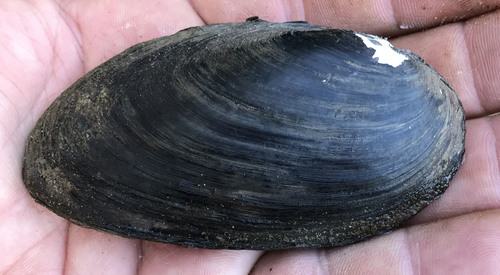


Gulf Spike
elliptio pullata
The Gulf Spike (Elliptio pullata) is a species of freshwater mussel belonging to the family Unionidae, found in rivers and streams of the southeastern United States. Like other freshwater mussels, it plays a vital role in maintaining the health of aquatic ecosystems by acting as a natural filter, cleaning the water by removing suspended particles and improving water clarity. This species spends most of its life partially buried in the substrate, making it a less conspicuous but incredibly important inhabitant of its freshwater habitat.
Hábitat: The Gulf Spike inhabits stable substrates of rivers, streams, and occasionally lakes, preferring areas with sand, gravel, or mixed sediments, often in moderate to swift currents.
The Gulf Spike typically possesses a moderately elongated, somewhat elliptical shell, which is usually brownish to dark brown or black in color, often appearing darker with age. The outer surface can be smooth or exhibit faint growth lines and subtle concentric ridges. Its shell is generally compressed to moderately inflated. Adults usually range from 4 to 10 centimeters in length, with the posterior end often slightly pointed or angled, giving it a somewhat 'spiked' appearance from which it derives its common name.
Categoría
InvertebrateRareza
Common
Peligro
1/5 · Muy bajo
Snaps
¡Sé la primera persona en hacer un snap!
Despite their sessile nature as adults, mussels are capable of slow movement using their muscular foot, burrowing into the substrate to find suitable conditions and avoid predators.
Freshwater mussels like the Gulf Spike can filter many liters of water per day, significantly improving water quality and clarity in their ecosystems.
The age of a Gulf Spike can often be estimated by counting the concentric growth rings on its shell, similar to tree rings.
The survival of juvenile Gulf Spikes is entirely dependent on finding a suitable fish host for their parasitic larval stage (glochidia), making fish conservation critical for mussel populations.
This mussel is a powerful filter feeder, drawing in water and sifting out microscopic food particles, which significantly contributes to water purification and clarity in its aquatic environment.
Its larval stage, known as glochidia, are obligate parasites on the gills or fins of specific fish hosts, undergoing a metamorphosis before detaching and settling as juvenile mussels.
While adults are largely sessile, they can use a muscular foot to slowly burrow and anchor themselves firmly into the sediment, resisting displacement by water currents.
The Gulf Spike is a filter feeder, consuming microscopic organic particles suspended in the water column, which include detritus, algae, bacteria, and protozoa.
Micropterus salmoides
The larvae (glochidia) of the Gulf Spike attach to the gills of fish to complete their development.
Procyon lotor
Juvenile and adult mussels are preyed upon by various aquatic and semi-aquatic mammals.
Chlorophyta
Mussels feed on microscopic algae present in the water column.
Bacteria
Mussels contribute to the nutrient cycling and primary production of aquatic ecosystems.
Aún no hay insignias de rasgos asignadas a este objeto.
Todavía no hay alias listados.
Las colecciones para este objeto aparecerán aquí a medida que se añadan más temas.
Peligro
1/5 · Muy bajo
Todavía no hay notas especiales de seguridad.
La forma más fácil de identificar a Gulf Spike es usar la aplicación de identificación de naturaleza Snappit.
4-10 cm
0.02-0.15 kg
10-25 años
The Gulf Spike is a filter feeder, consuming microscopic organic particles suspended in the water column, which include detritus, algae, bacteria, and protozoa.
The Gulf Spike inhabits stable substrates of rivers, streams, and occasionally lakes, preferring areas with sand, gravel, or mixed sediments, often in moderate to swift currents.
Filtering
20000-80000
Acércate para separar los grupos y explorar dónde se ha fotografiado este objeto.
Los snaps recientes aparecerán aquí a medida que se añadan nuevas observaciones.