

Gumboot Chiton
cryptochiton stelleri
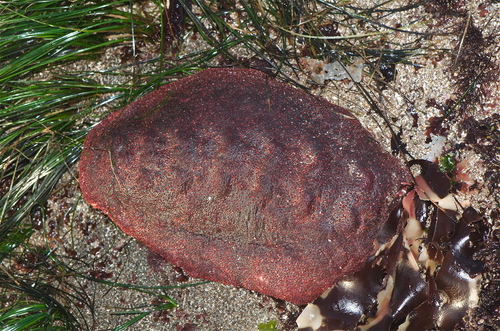
The Gumboot Chiton (Cryptochiton stelleri), affectionately nicknamed the 'wandering meatloaf', holds the unique title of the largest chiton species in the world. Unlike its smaller, heavily armored relatives, this peculiar marine mollusk has completely internalized its protective shell. Instead of visible dorsal plates, it boasts a thick, leathery, brick-red mantle that gives it an uncanny resemblance to a discarded piece of meat or an overgrown potato resting in a tide pool. Found along the rugged, wave-swept coastlines of the North Pacific, it slowly glides over rocks using a large, muscular foot. Despite its sluggish and unassuming appearance, this gentle giant is a fascinating marvel of marine biology, possessing iron-tipped teeth capable of effortlessly scraping tough algae from jagged rocks.
Hábitat: Found clinging tightly to rocky substrates in low intertidal and shallow subtidal zones along the wave-swept coasts of the North Pacific Ocean.
The Gumboot Chiton is instantly recognizable by its large, elongated oval shape and its thick, leathery, reddish-brown to brick-red skin (mantle). It can grow up to 36 centimeters long and weigh over a kilogram, making it significantly larger than any other chiton. Unlike other species in its class, its eight butterfly-shaped shell plates are entirely hidden beneath its tough skin, making the dorsal surface look smooth, velvety, and somewhat lumpy. If overturned, its underside reveals a pale, yellowish-orange muscular foot surrounded by a fleshy groove containing its gills.
Categoría
InvertebrateRareza
Common
Peligro
1/5 · Muy bajo
Snaps
¡Sé la primera persona en hacer un snap!
In the past, Indigenous peoples of the Pacific Northwest and early Russian settlers occasionally ate this chiton, though it is famously tough, rubbery, and notoriously bland.
It is affectionately nicknamed the 'wandering meatloaf' because of its brick-red, lumpy appearance and remarkably sluggish nature.
Its teeth are coated in magnetite, meaning they contain enough naturally occurring iron to be easily picked up by a household magnet.
The white, calcified plates hidden inside its back are shaped exactly like butterflies. When a chiton dies and decays, these wash ashore and are often mistaken for fossilized insects by beachcombers.
Its radula (tongue-like structure) is lined with teeth capped with magnetite, an extremely hard iron ore that allows it to efficiently scrape tough algae from rocks without wearing down.
It has eight heavily calcified, butterfly-shaped plates embedded entirely beneath its leathery skin, providing structural support and protection while remaining completely hidden from view.
Its massive, muscular foot acts as a powerful suction cup, allowing it to withstand crashing waves and powerful currents in turbulent intertidal zones without being dislodged.
It is a slow-moving benthic grazer that sustains itself by scraping various types of marine algae and kelp off rocky surfaces.
Diferencias por edad: Larvae are non-feeding and planktonic for a few days, whereas adults are strictly benthic grazers.
Pycnopodia helianthoides
Giant sea stars are one of the few natural predators capable of attacking and consuming adult gumboot chitons.
Enhydra lutris
Sea otters occasionally forage for gumboot chitons, using rocks to pry them off their substrates.
Arctonoe vittata
Frequently hosts this scale worm in its pallial groove, providing the worm shelter without being harmed.
Macrocystis pyrifera
The chiton acts as an important grazer in kelp forest ecosystems, primarily feeding on fragments of this kelp.
Aún no hay insignias de rasgos asignadas a este objeto.
Todavía no hay alias listados.
Las colecciones para este objeto aparecerán aquí a medida que se añadan más temas.
Peligro
1/5 · Muy bajo
Todavía no hay notas especiales de seguridad.
La forma más fácil de identificar a Gumboot Chiton es usar la aplicación de identificación de naturaleza Snappit.
15-36 cm
0.5-2 kg
20-40 años
It is a slow-moving benthic grazer that sustains itself by scraping various types of marine algae and kelp off rocky surfaces.
Found clinging tightly to rocky substrates in low intertidal and shallow subtidal zones along the wave-swept coasts of the North Pacific Ocean.
Grazing
15000-95000
Acércate para separar los grupos y explorar dónde se ha fotografiado este objeto.
Los snaps recientes aparecerán aquí a medida que se añadan nuevas observaciones.

California, US
Puedes ver Foca Común, Ochre Sea Star y Clavelina De Mar.
Ver guía →

California, US
Puedes ver Elefante Marino Del Norte, Gumboot Chiton y Ochre Sea Star.
Ver guía →

Washington, US
Puedes ver Ciervo Mulo, Verbena De Arena Amarilla y águila Calva.
Ver guía →