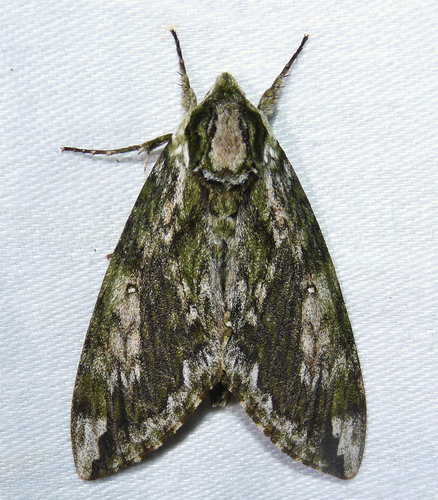


Hagen'S Sphinx
ceratomia hageni
Hagen's Sphinx (Ceratomia hageni) is a fascinating member of the hawkmoth family, Sphingidae, native to the central and eastern United States. Renowned for its superb camouflage and rapid, agile flight, this moth blends seamlessly into the bark of its favorite trees during the day. As dusk falls, it takes to the air with remarkable precision, hovering before deep-throated flowers to sip nectar like a miniature hummer. The life cycle of Hagen's Sphinx is intimately tied to the Osage-orange tree, on which its vibrant green hornworm caterpillars feed, offering a peak into the intricate co-evolutionary relationships of North America's deciduous woodlands.
Hábitat: Typically found in deciduous woodlands, river valleys, and edge habitats where its primary host plant, the Osage-orange tree, is abundant.
Hagen's Sphinx is characterized by its mottled grayish-brown forewings, which are intricately patterned with wavy black, white, and gray lines that perfectly mimic tree bark. The hindwings are a more uniform, dusky grayish-brown with faint, darker bands. The species has a wingspan of approximately 8 to 12 centimeters. Its robust, torpedo-shaped body is covered in fine, hair-like scales, and it features a distinctive white spot near the center of each forewing, helping to break up its outline against predators.
Categoría
InsectosRareza
Common
Peligro
1/5 · Muy bajo
Snaps
¡Sé la primera persona en hacer un snap!
Its distribution is heavily tied to the historical planting of Osage-orange trees, which were widely used by early American settlers as natural livestock fences.
Like many sphinx moths, Hagen's Sphinx can beat its wings up to 85 times per second, creating a soft humming sound in flight.
The caterpillar of this species features a sharp-looking 'horn' on its rear end, which is harmless but acts as a visual deterrent to predators.
The intricate, wavy gray-and-brown patterns on its forewings allow it to blend seamlessly into tree bark, making it virtually invisible to diurnal predators.
Utilizing rapid wing beats, it can hover stationary in mid-air and fly backwards or sideways while feeding on nectar.
Equipped with specialized auditory organs, this moth can detect the echolocation clicks of insectivorous bats, allowing it to perform evasive diving maneuvers.
Caterpillars feed voraciously on the leaves of the Osage-orange, while adult moths sip nectar from deep-tubed nocturnal flowers.
Maclura pomifera
The primary larval host plant where females lay eggs and caterpillars feed on the foliage.
Eptesicus fuscus
A common nocturnal aerial predator that hunts adult moths using echolocation.
Cyanocitta cristata
A diurnal avian predator that actively searches tree trunks for camouflaged moths and caterpillars.
Aún no hay insignias de rasgos asignadas a este objeto.
Todavía no hay alias listados.
Las colecciones para este objeto aparecerán aquí a medida que se añadan más temas.
Peligro
1/5 · Muy bajo
Todavía no hay notas especiales de seguridad.
La forma más fácil de identificar a Hagen'S Sphinx es usar la aplicación de identificación de naturaleza Snappit.
3+ cm
8+ cm
0.001+ kg
1+ años
18 km/h
Caterpillars feed voraciously on the leaves of the Osage-orange, while adult moths sip nectar from deep-tubed nocturnal flowers.
Typically found in deciduous woodlands, river valleys, and edge habitats where its primary host plant, the Osage-orange tree, is abundant.
Acércate para separar los grupos y explorar dónde se ha fotografiado este objeto.
Los snaps recientes aparecerán aquí a medida que se añadan nuevas observaciones.















.jpg&width=800)

