

Hairy-Eyed Bee-Mimic Fly
mallota posticata
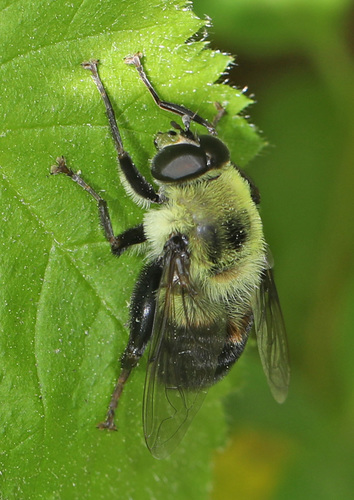
The Hairy-Eyed Bee-Mimic Fly (Mallota posticata) is a remarkable species of hoverfly native to North America. At first glance, this insect is frequently mistaken for a bumblebee due to its dense, fuzzy coat of yellow and black hairs and its robust body shape. This mimicry is a classic example of Batesian mimicry, protecting the harmless fly from predators by making it appear armed with a stinger. In reality, these flies are gentle pollinators that play a key role in forest ecosystems, visiting a wide variety of spring wild flowers. While adults spend their time in the canopy and understory searching for nectar, the larvae have a vastly different, semi-aquatic lifestyle. They develop in wet, decaying wood cavities and tree holes, where they feed on organic debris and help recycle nutrients back into the forest.
Hábitat: Found in mature deciduous and mixed woodlands, particularly near damp areas, swamps, and forests with older trees containing water-filled rot holes.
This medium-to-large hoverfly, typically measuring 1.2 to 1.6 centimeters in length, mimics a bumblebee with a dense covering of yellow hair on its thorax and the front of its abdomen, followed by black hairs toward the rear. Its most distinguishing feature is its large compound eyes, which are covered in fine, short hairs visible under close magnification. The wings are clear with dark, well-defined veins, and because it is a true fly, it possesses only a single pair of wings and short, three-segmented antennae, unlike the four wings and long antennae of the bees it mimics.
Categoría
InsectosRareza
Common
Peligro
1/5 · Muy bajo
Snaps
¡Sé la primera persona en hacer un snap!
Despite looking exactly like a stinging bumblebee, this hoverfly is completely harmless and lacks a stinger entirely.
Its larvae are known as 'rat-tailed maggots' because of their long, telescopic tail-like breathing tube.
The fine hairs on its compound eyes may help detect wind currents or prevent sticky pollen from obstructing its vision.
They are incredibly agile flyer and can fly backwards and sideways to escape predators.
Mimics the appearance, buzzing flight sound, and behavior of bumblebees to deter avian predators.
Utilizes rapid, independent wing beat adjustments to hover perfectly still in mid-air before darting away instantly.
The aquatic larvae possess a long, retractable breathing tube that allows them to extract atmospheric oxygen while submerged in oxygen-depleted decay pools.
Adults feed primarily on the nectar and pollen of spring-blooming forest flowers, while the aquatic larvae are detritivores feeding on decaying plant matter.
Diferencias por edad: Larvae are aquatic detritivores that consume rotting organic material and associated microbes in tree holes, whereas adults feed exclusively on floral nectar and pollen.
Bombus impatiens
The fly mimics this common stinging bee to gain protection from visual predators like birds.
Quercus alba
Provides critical breeding habitat, as larvae develop inside the tree's wet, decaying wood cavities.
Myiarchus crinitus
This insectivorous bird preys on adult hoverflies in the forest understory.
Aún no hay insignias de rasgos asignadas a este objeto.
Todavía no hay alias listados.
Las colecciones para este objeto aparecerán aquí a medida que se añadan más temas.
Peligro
1/5 · Muy bajo
Todavía no hay notas especiales de seguridad.
La forma más fácil de identificar a Hairy-Eyed Bee-Mimic Fly es usar la aplicación de identificación de naturaleza Snappit.
12-16 cm
2-3 cm
0.0001-0.0003 kg
15 km/h
Adults feed primarily on the nectar and pollen of spring-blooming forest flowers, while the aquatic larvae are detritivores feeding on decaying plant matter.
Found in mature deciduous and mixed woodlands, particularly near damp areas, swamps, and forests with older trees containing water-filled rot holes.
Foraging
Acércate para separar los grupos y explorar dónde se ha fotografiado este objeto.
Los snaps recientes aparecerán aquí a medida que se añadan nuevas observaciones.