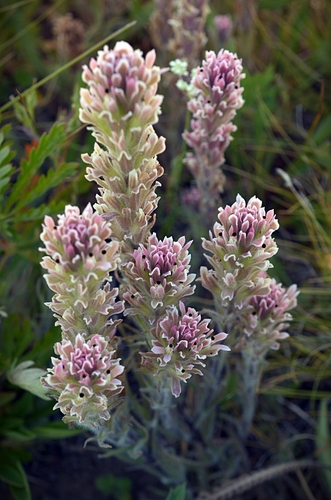


Hairy Paintbrush
castilleja pilosa
The Hairy Paintbrush (Castilleja pilosa) is a fascinating perennial wildflower native to the montane and subalpine regions of the western United States. Belonging to the broomrape family, Orobanchaceae, this plant is renowned not just for its unique fuzzy appearance but for its complex, hemiparasitic lifestyle. While it possesses green leaves and can perform photosynthesis, it routinely steals additional water and essential nutrients by latching onto the roots of neighboring plants. This strategy allows it to thrive in nutrient-poor, dry soils where other wildflowers might struggle. Its striking, brush-like clusters of colorful bracts make it a beloved sight for hikers and nature enthusiasts exploring the high meadows and sagebrush scrublands of the American West.
Hábitat: Typically found in dry, open gravelly slopes, sagebrush scrub, and montane pine forests at moderate to high elevations.
This low-growing perennial stands between 10 and 30 centimeters tall, characterized by its remarkably hairy stems and leaves, which are covered in soft, spreading white hairs. The foliage is gray-green, and the leaves are often deeply lobed. The true flowers are slender, tubular, and greenish-yellow, but they are mostly hidden by showy, paintbrush-like bracts that range in color from pale yellow and greenish-white to dull purplish-red. These specialized leaf bracts clump at the top of the stem, giving the plant its classic dipped-in-paint appearance.
Categoría
PlantasRareza
Common
Peligro
1/5 · Muy bajo
Snaps
¡Sé la primera persona en hacer un snap!
Because they absorb selenium and other heavy metals from the soil through their hosts, some paintbrush species can be toxic to herbivores.
Hairy Paintbrush is incredibly difficult to grow in gardens because it requires a compatible host plant's root system to survive past the seedling stage.
The bright 'flowers' of the paintbrush are actually modified leaves called bracts; the true flowers are small, narrow green tubes hidden within.
As a hemiparasite, it develops specialized root structures called haustoria to penetrate the roots of host plants, absorbing water and mineral nutrients directly from them.
The dense covering of long, soft hairs acts as insulation against harsh alpine winds and reduces water loss by trapping a layer of humid air close to the plant's surface.
It colors its modified leaves, known as bracts, instead of its petals to attract pollinators, saving energy while maintaining high visibility in sparse landscapes.
While capable of producing energy via photosynthesis, it relies heavily on extracting water, minerals, and organic compounds from the roots of host plants.
Diferencias por edad: Seedlings rely initially on seed reserves before establishing a haustorial connection to a host plant.
Artemisia tridentata
Castilleja pilosa parasitizes the root system of this dominant shrub to obtain vital water and nutrients.
Bombus huntii
Provides nectar to bumblebees, which serve as its primary pollinators.
Aún no hay insignias de rasgos asignadas a este objeto.
Todavía no hay alias listados.
Las colecciones para este objeto aparecerán aquí a medida que se añadan más temas.
Peligro
1/5 · Muy bajo
Todavía no hay notas especiales de seguridad.
La forma más fácil de identificar a Hairy Paintbrush es usar la aplicación de identificación de naturaleza Snappit.
10-30 cm
3-10 años
While capable of producing energy via photosynthesis, it relies heavily on extracting water, minerals, and organic compounds from the roots of host plants.
Typically found in dry, open gravelly slopes, sagebrush scrub, and montane pine forests at moderate to high elevations.
Parasitism
Acércate para separar los grupos y explorar dónde se ha fotografiado este objeto.
Los snaps recientes aparecerán aquí a medida que se añadan nuevas observaciones.













