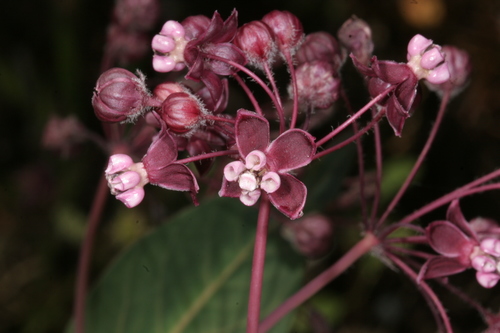


Heart-Leaf Milkweed
asclepias cordifolia
The Heart-Leaf Milkweed (Asclepias cordifolia) is a stunning perennial herb native to the slopes and woodlands of California and southern Oregon. Instantly recognizable by its striking heart-shaped, clasping leaves that wrap directly around dark purple stems, this resilient wildflower brings vibrant life to dry, rocky environments. In late spring and early summer, it produces spherical clusters of beautiful, deep-maroon to pink star-shaped flowers that emit a sweet, heavy fragrance, drawing in a wide variety of native pollinators. Beyond its visual charm, Heart-Leaf Milkweed plays a crucial role in Western ecosystems as an essential larval host plant for the monarch butterfly, providing nourishment and defense mechanisms for developing caterpillars. It has also historically held ethnobotanical value, with Native American tribes utilizing its strong stem fibers for cordage and its sap for various medicinal applications. This tough plant is a true symbol of West Coast chaparral and open forest habitats.
Hábitat: Found on dry, rocky slopes, chaparral, and open coniferous forests at elevations between 50 and 2,000 meters.
This herbaceous perennial grows up to 100 centimeters tall, featuring thick, upright stems that are often a rich, purplish-green. Its most distinctive feature is its opposite, clasping, heart-shaped (cordate) leaves that lack stalks, appearing to embrace the stem directly. The leaves are bluish-green, sometimes tinged with purple. Its nodding flower clusters (umbels) bear numerous star-like blossoms, each with deep-maroon to purplish-pink hoods and reflexed petals, creating a complex and beautiful multi-layered appearance.
Categoría
PlantasRareza
Common
Peligro
1/5 · Muy bajo
Snaps
¡Sé la primera persona en hacer un snap!
Its specific epithet 'cordifolia' translates from Latin to 'heart-leaved', directly referencing its beautifully shaped, clasping foliage.
Monarch butterfly caterpillars that eat Heart-Leaf Milkweed incorporate the plant's cardiac glycosides into their own bodies, making themselves highly toxic to birds.
The strong, fibrous bark of the stems was harvested by indigenous peoples, such as the Miwok, to spin high-quality ropes, fishing lines, and nets.
The plant produces a milky latex sap rich in cardenolides, which are toxic cardiac glycosides that deter most herbivores from eating its tissues.
Its broad, clasping leaves act as efficient funnels, capturing dew and sparse rainwater and directing it down the stem directly to its root system.
It possesses a deep, woody taproot system that stores water and nutrients, allowing it to survive hot, dry summers and regenerate after wildfires.
As a photoautotroph, this plant manufactures its own food through photosynthesis, utilizing sunlight, carbon dioxide, and water while absorbing key nutrients from the soil.
Danaus plexippus
Caterpillars of the monarch butterfly feed exclusively on milkweed foliage, storing the plant's toxins to defend themselves against predators.
Bombus vosnesenskii
Yellow-faced bumble bees frequently visit the flowers to gather nectar, serving as crucial pollinators for the species.
Oncopeltus fasciatus
This specialized insect feeds on the seeds and plant fluids, utilizing the milkweed's toxins for its own defense.
Aún no hay insignias de rasgos asignadas a este objeto.
Todavía no hay alias listados.
Las colecciones para este objeto aparecerán aquí a medida que se añadan más temas.
Peligro
1/5 · Muy bajo
Todavía no hay notas especiales de seguridad.
La forma más fácil de identificar a Heart-Leaf Milkweed es usar la aplicación de identificación de naturaleza Snappit.
30-100 cm
5-20 años
As a photoautotroph, this plant manufactures its own food through photosynthesis, utilizing sunlight, carbon dioxide, and water while absorbing key nutrients from the soil.
Found on dry, rocky slopes, chaparral, and open coniferous forests at elevations between 50 and 2,000 meters.
Photosynthesis
Acércate para separar los grupos y explorar dónde se ha fotografiado este objeto.
Los snaps recientes aparecerán aquí a medida que se añadan nuevas observaciones.

California, US
Puedes ver Western Redbud, Harlequin Lupine y California Yerba Santa.
Ver guía →

California, US
Puedes ver Ardilla Terrestre De California y Lagartija Espinosa Del Oeste.
Ver guía →















