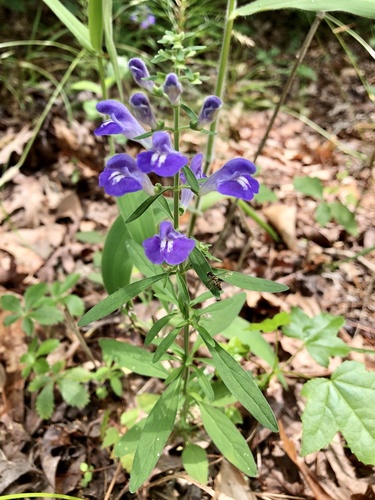


Helmet Skullcap
scutellaria integrifolia
Helmet Skullcap, scientifically known as Scutellaria integrifolia, is a delightful perennial wildflower native to the eastern United States. This member of the mint family stands out in grassy meadows and open woodlands with its striking upright spikes of blue to violet flowers. It is widely recognized for its unique cap-like calyx, which covers the seeds and gives the genus its characteristic name. Unlike many of its pungent mint relatives, Helmet Skullcap does not possess a strong minty aroma, but its ecological role and charming appearance make it a favorite for native plant enthusiasts.
Hábitat: Typically found in moist to dry pine flatwoods, open woodlands, meadows, and along grassy roadsides.
This wildflower features slender, upright, and softly hairy square stems growing between 30 to 70 centimeters tall. The leaves are opposite, with the lower leaves being ovate and lightly toothed, transitioning to narrower, lance-shaped, smooth-edged leaves near the top. Its trumpet-shaped flowers are light blue to rich violet-purple, ending in a prominent white throat with subtle nectar guides. The defining visual trait is the tiny green calyx behind the flower, which resembles a miniature helmet or cap.
Categoría
PlantasRareza
Common
Peligro
1/5 · Muy bajo
Snaps
¡Sé la primera persona en hacer un snap!
Despite belonging to the Lamiaceae (mint) family, Helmet Skullcap does not have the aromatic, minty scent typically associated with its relatives.
The genus name 'Scutellaria' is derived from the Latin word 'scutella', meaning a small dish or cup, describing the shape of the calyx.
When the seeds reach maturity, the helmet-like cap of the calyx pops off to help fling the seeds outward into the surrounding soil.
The calyx folds into a tight, helmet-like shield over the developing seeds, protecting them from pests and early decay until they are ready to disperse.
Intricate white markings on the flower's lower lip act as landing lights, steering specialized insect pollinators directly to its nectar reserve.
Its stems and leaves are covered in fine, sticky glandular hairs containing bitter compounds that discourage grazing animals.
Like other green plants, Helmet Skullcap generates its energy internally through photosynthesis, converting sunlight, water, and carbon dioxide into sugars.
Bombus impatiens
Provides energy-rich nectar to this key native pollinator, which has the strength and tongue length to access the flower's deep tube.
Myzus persicae
Sucks sap from the tender stems of the plant, occasionally introducing plant pathogens.
Aún no hay insignias de rasgos asignadas a este objeto.
Todavía no hay alias listados.
Las colecciones para este objeto aparecerán aquí a medida que se añadan más temas.
Peligro
1/5 · Muy bajo
Todavía no hay notas especiales de seguridad.
La forma más fácil de identificar a Helmet Skullcap es usar la aplicación de identificación de naturaleza Snappit.
30-70 cm
2-5 años
Like other green plants, Helmet Skullcap generates its energy internally through photosynthesis, converting sunlight, water, and carbon dioxide into sugars.
Typically found in moist to dry pine flatwoods, open woodlands, meadows, and along grassy roadsides.
Acércate para separar los grupos y explorar dónde se ha fotografiado este objeto.
Los snaps recientes aparecerán aquí a medida que se añadan nuevas observaciones.












