

Hoary Pincushion
chaenactis douglasii
The Hoary Pincushion (Chaenactis douglasii) is a resilient, biennial or short-lived perennial wildflower native to the arid and mountainous regions of western North America. Belonging to the aster family, this species is well-adapted to survive in harsh, rocky, and sandy soils where other plants struggle. It is easily recognized by its dusty, cobwebby appearance, which is actually a dense covering of fine white hairs designed to conserve moisture in dry environments. Throughout the summer, the Hoary Pincushion produces clusters of delicate white to pale pink flower heads. These flower heads lack the outer ray petals typical of many asters, giving them a distinct, rounded appearance reminiscent of a classic sewing pincushion. It plays an important role in its native ecosystem, providing vital nectar for native bees, butterflies, and other pollinators in dry sagebrush steppes and pine forests.
Hábitat: Found in dry, open habitats including sagebrush deserts, sandy plains, gravelly volcanic slopes, and open ponderosa pine forests.
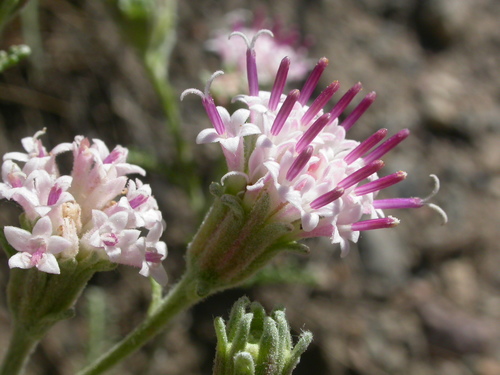
This species grows as an erect herb, ranging from 10 to 60 centimeters in height. Its stems and deeply lobed, fern-like leaves are densely covered in white, woolly, or cobweb-like hairs, giving the entire plant a dusty, grayish-green or 'hoary' look. The flower heads are clustered at the ends of the stems, featuring numerous tubular, five-lobed disk florets that range from pure white to a soft, pastel pink. The outstanding feature is the complete absence of ray florets, giving each flower head a tight, dome-like, pincushion appearance studded with protruding, dark-tipped stamens.
Categoría
PlantasRareza
Common
Peligro
1/5 · Muy bajo
Snaps
¡Sé la primera persona en hacer un snap!
Its common name 'hoary' refers to the grayish-white, cobwebby hairs that give it a frosted or dusty look, protecting it from drying out in harsh sun.
Native American tribes, including the Okanogan-Colville, historically used infusions of the root and leaves as a wash for sore eyes and skin irritations.
Unlike classic daisies or sunflowers, the hoary pincushion's flower heads completely lack showy outer ray petals, consisting entirely of tightly packed disk florets.
Densely matted white hairs reflect intense solar radiation and reduce wind-induced evaporation, conserving vital moisture.
Features a strong, deep taproot that stabilizes the plant in loose gravel, volcanic pumice, and shifting sandy soils.
Can maintain cellular function and photosynthetic activity under extreme heat and highly prolonged dry spells.
As a photosynthetic plant, it manufactures its own sugars using sunlight, water, and carbon dioxide, while absorbing essential minerals from the soil.
Apis mellifera
Pollinates the flowers while gathering nectar.
Vanessa cardui
Feeds on the nectar of the blossoms during its migration.
Sylvilagus nuttallii
Occasionally browses on the foliage and flower heads.
Aún no hay insignias de rasgos asignadas a este objeto.
Todavía no hay alias listados.
Las colecciones para este objeto aparecerán aquí a medida que se añadan más temas.
Peligro
1/5 · Muy bajo
Todavía no hay notas especiales de seguridad.
La forma más fácil de identificar a Hoary Pincushion es usar la aplicación de identificación de naturaleza Snappit.
10-60 cm
2-5 años
As a photosynthetic plant, it manufactures its own sugars using sunlight, water, and carbon dioxide, while absorbing essential minerals from the soil.
Found in dry, open habitats including sagebrush deserts, sandy plains, gravelly volcanic slopes, and open ponderosa pine forests.
Acércate para separar los grupos y explorar dónde se ha fotografiado este objeto.
Los snaps recientes aparecerán aquí a medida que se añadan nuevas observaciones.

Montana, US
Puedes ver Centaurea Manchada, Gordolobo y Cebolla De Flor Caída.
Ver guía →

Idaho, US
Puedes ver Limber Pine, Dwarf Purple Monkeyflower y Cushion Buckwheat.
Ver guía →