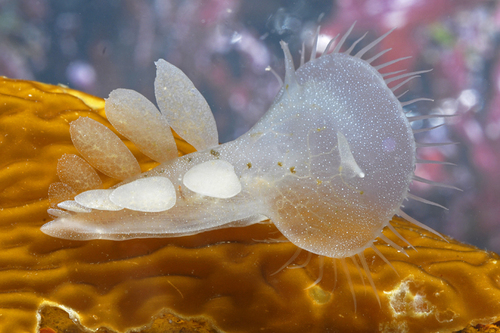


Hooded Nudibranch
melibe leonina
The Hooded Nudibranch, scientifically known as Melibe leonina, is one of the ocean's most peculiar and fascinating sea slugs. Resembling a gelatinous, translucent alien, this unique mollusk abandons the typical snail-like feeding habits for a spectacular, Venus flytrap-like hunting method. Instead of scraping algae or stationary sponges, it casts a large, fringed oral hood into the water column to snare microscopic planktonic prey. Beyond its bizarre appearance and predatory prowess, the Hooded Nudibranch is famous among tide-poolers and divers for a highly unusual defense mechanism: when disturbed or lifted from the water, it emits a distinct, sweet fragrance that smells strikingly like watermelon or citrus. Combining its spectral beauty, acrobatic swimming style, and sweet scent, it remains a beloved highlight of the Pacific kelp forests.
Hábitat: Found in shallow coastal waters, predominantly clinging to the blades of giant kelp and eelgrass in bays and kelp forests.
This nudibranch is highly distinct due to its translucent, pale yellow to greenish-brown body, which provides excellent camouflage among kelp fronds. It grows up to 10 centimeters in length and is easily identified by its massive, expandable oral hood that is fringed with sensitive, interlocking tentacles. Along its back run four to six pairs of large, flattened, paddle-like appendages called cerata. Because of its gelatinous transparency, a complex network of brownish internal digestive branches is often visible inside its body and cerata.
Categoría
InvertebrateRareza
Common
Peligro
1/5 · Muy bajo
Snaps
¡Sé la primera persona en hacer un snap!
Because they are nearly transparent, you can often see the small crustaceans they have just eaten moving inside their digestive tracts.
During mating season, they often gather in massive 'blooms' on kelp beds, where hundreds of individuals can be found clustered together laying spiraling, ribbon-like egg masses.
Unlike most other nudibranchs and sea snails, the Hooded Nudibranch completely lacks a radula (a scraping tongue), relying entirely on its hood to swallow prey whole.
When dislodged from their kelp homes, they can swim by vigorously thrashing their bodies upside-down from side to side, looking like an awkward, transparent fish.
It uses a large, expandable hood fringed with tentacles to sweep the water and snap shut over tiny crustaceans, functioning much like a Venus flytrap.
When threatened or handled, it secretes a chemical defense from its glands that smells strongly of watermelon or fruity candy to deter predators.
If attacked, it can easily detach the large, paddle-like cerata on its back to distract a predator while making its escape, slowly regenerating them over time.
It feeds almost exclusively on tiny planktonic crustaceans by casting its oral hood like a net and trapping them.
Diferencias por edad: Larvae are planktotrophic, feeding on microscopic phytoplankton before settling on kelp and developing their adult predatory hood.
Macrocystis pyrifera
Lives upon and uses the fronds as hunting grounds.
Zostera marina
Relies on these marine plants for shelter and breeding grounds in muddy bays.
Gammaridea
Serves as a primary food source trapped by the nudibranch's hood.
Pugettia producta
Occasionally preys upon the nudibranch despite its chemical defenses.
Aún no hay insignias de rasgos asignadas a este objeto.
Todavía no hay alias listados.
Las colecciones para este objeto aparecerán aquí a medida que se añadan más temas.
Peligro
1/5 · Muy bajo
Todavía no hay notas especiales de seguridad.
La forma más fácil de identificar a Hooded Nudibranch es usar la aplicación de identificación de naturaleza Snappit.
4-10 cm
0.002-0.02 kg
1 años
It feeds almost exclusively on tiny planktonic crustaceans by casting its oral hood like a net and trapping them.
Found in shallow coastal waters, predominantly clinging to the blades of giant kelp and eelgrass in bays and kelp forests.
Trapping
10000-100000
Acércate para separar los grupos y explorar dónde se ha fotografiado este objeto.
Los snaps recientes aparecerán aquí a medida que se añadan nuevas observaciones.




.jpg&width=800)








