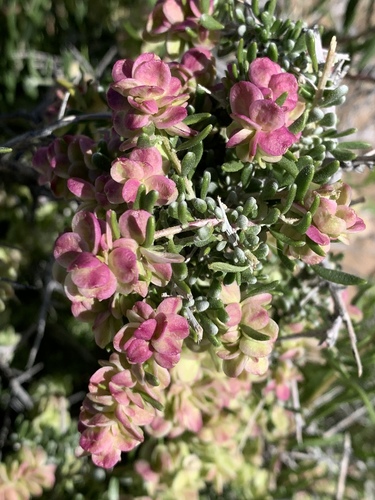


Hopsage
grayia spinosa
Spiny hopsage (Grayia spinosa) is a hardy, woody shrub native to the arid desert and steppe regions of western North America. This resilient perennial is a vital component of the sagebrush ecosystem, providing critical nourishment and shelter to a wide range of desert wildlife. Its name comes from the striking resemblance of its leafy bracts to the hops used in brewing, which burst into brilliant shades of pink, rose, and cream during the spring blooming season. Beyond its aesthetic appeal, spiny hopsage plays an important ecological role in stabilizing sandy soils and preventing erosion. It has evolved remarkable survival strategies to thrive in harsh, water-restricted climates where few other plants can persist.
Hábitat: Found in dry, sandy, or gravelly soils across sagebrush steppes, desert flats, and pinyon-juniper woodlands of western North America.
This deciduous shrub typically grows between 30 and 150 centimeters tall, forming a rounded, highly branched mound. Its rigid, greyish-brown branches terminate in sharp, spine-like tips. The leaves are small, narrow, and fleshy, with a distinct scoop-like shape and a whitish, scurfy coating. The most eye-catching feature is the cluster of female flowers, which are wrapped in flattened, papery, circular bracts that measure about 1 to 1.5 centimeters in diameter and turn a vibrant rose-pink, red, or greenish-yellow in spring.
Categoría
PlantasRareza
Common
Peligro
1/5 · Muy bajo
Snaps
¡Sé la primera persona en hacer un snap!
Although they look like colorful petals, the vibrant pink 'flowers' of the hopsage are actually modified leaves called bracts that protect the developing seeds.
Native American tribes, including the Paiute, historically used the hard, spiny wood of the hopsage to make arrow shafts and digging sticks.
The genus name Grayia honors Asa Gray, a highly influential 19th-century American botanist who helped synthesize Charles Darwin's theories with plant science.
To survive extreme summer heat and water scarcity, this plant can shed its leaves prematurely to dramatically reduce water loss through transpiration.
The tips of its rigid twigs harden into sharp, protective spines that deter larger mammalian herbivores from overgrazing.
The seeds are encased in lightweight, papery, disk-shaped wings that easily catch the desert breeze, allowing them to disperse far from the parent plant.
As a photosynthetic plant, spiny hopsage synthesizes its own food using sunlight, carbon dioxide, and water while drawing essential minerals from the soil.
Antilocapra americana
Pronghorns browse heavily on the nutrient-rich leaves and twigs of spiny hopsage during the winter months.
Centrocercus urophasianus
Sage-grouse use the dense canopy of spiny hopsage for nesting cover, camouflage, and protection from aerial predators.
Lepus californicus
Jackrabbits feed on the tender young shoots and leaves of the hopsage in early spring.
Aún no hay insignias de rasgos asignadas a este objeto.
Todavía no hay alias listados.
Las colecciones para este objeto aparecerán aquí a medida que se añadan más temas.
Peligro
1/5 · Muy bajo
Todavía no hay notas especiales de seguridad.
La forma más fácil de identificar a Hopsage es usar la aplicación de identificación de naturaleza Snappit.
30-150 cm
15-40 años
As a photosynthetic plant, spiny hopsage synthesizes its own food using sunlight, carbon dioxide, and water while drawing essential minerals from the soil.
Found in dry, sandy, or gravelly soils across sagebrush steppes, desert flats, and pinyon-juniper woodlands of western North America.
Acércate para separar los grupos y explorar dónde se ha fotografiado este objeto.
Los snaps recientes aparecerán aquí a medida que se añadan nuevas observaciones.