

Iberian Rock Lizard
iberolacerta monticola
The Iberian Rock Lizard is a striking reptile adapted specifically to the rugged alpine landscapes of the northwestern Iberian Peninsula. Finding refuge among glacier-carved scree slopes and granite boulder fields, this species is a master of survival in extreme high-altitude environments where winters are harsh and summers are brief. They are highly active during warm sunny days, leaping across vertical rock faces with astonishing agility. These lizards play a crucial role in their high-mountain ecosystems as both predators of small invertebrates and prey for montane birds and snakes. Their unique coloration and resilience make them a fascinating find for hikers exploring the peaks of Spain and Portugal.
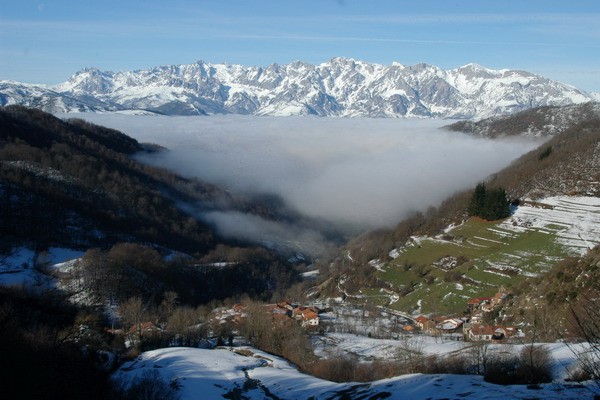
Hábitat: Found in high-altitude rocky environments, scree slopes, and stone walls above the treeline in mountain ranges.
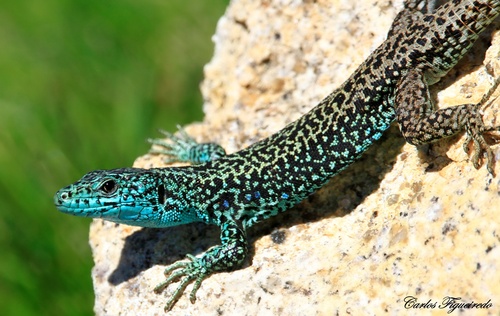
The Iberian Rock Lizard features a noticeably flattened body and head, adapted for squeezing into tight rock crevices. Adult males typically exhibit a vibrant green or olive-green back marked with dark, intricate reticulated or spotted patterns, while females and juveniles tend to be brown or greyish. Many individuals feature a row of brilliant blue spots along the outer edge of their belly scales. They generally reach a total length of 15 to 22 centimeters, including their long, slender tail, which is often longer than their body.
Categoría
ReptilesRareza
Common
Peligro
1/5 · Muy bajo
Snaps
¡Sé la primera persona en hacer un snap!
During the harsh winter months, these lizards enter a state of brumation, surviving under deep snow blankets inside deep rock crevices.
Males change their coloration during the breeding season, with their green backs becoming exceptionally bright to attract females and signal dominance.
This species is a glacial relict, meaning its populations became isolated on high mountain peaks as glaciers retreated after the last Ice Age.
Can voluntarily shed its tail when grabbed by a predator, allowing the lizard to escape while the wriggling tail distracts the attacker.
Possesses specialized basking behaviors and a dark skin base that maximizes absorption of weak solar radiation in cold alpine habitats.
Features sharp, curved claws and long digits that provide exceptional friction and grip on near-vertical granite rock faces.
Feeds primarily on a wide variety of small alpine invertebrates, tracking down moving prey among rock cracks and alpine vegetation.
Diferencias por edad: Juveniles eat smaller soft-bodied insects like aphids and springtails, whereas adults consume harder beetles and larger spiders.
Musca domestica
Preys on flies to sustain its energy in harsh alpine climates.
Vipera seoanei
Predator that targets lizards basking on exposed rocks.
Falco tinnunculus
Aerial predator that hunts small reptiles on high-altitude slopes.
Aún no hay insignias de rasgos asignadas a este objeto.
Todavía no hay alias listados.
Las colecciones para este objeto aparecerán aquí a medida que se añadan más temas.
Peligro
1/5 · Muy bajo
Todavía no hay notas especiales de seguridad.
La forma más fácil de identificar a Iberian Rock Lizard es usar la aplicación de identificación de naturaleza Snappit.
14-22 cm
0.004-0.012 kg
8-15 años
8 km/h
Feeds primarily on a wide variety of small alpine invertebrates, tracking down moving prey among rock cracks and alpine vegetation.
Found in high-altitude rocky environments, scree slopes, and stone walls above the treeline in mountain ranges.
Foraging
Acércate para separar los grupos y explorar dónde se ha fotografiado este objeto.
Los snaps recientes aparecerán aquí a medida que se añadan nuevas observaciones.