


'Ie'Ie
freycinetia arborea
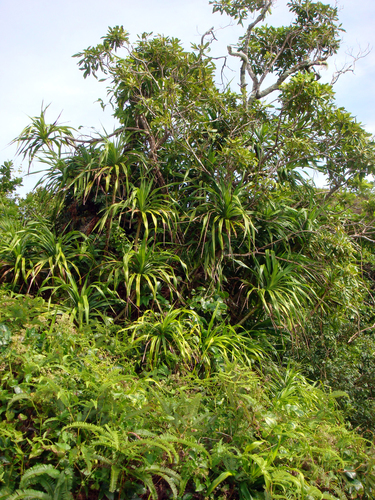
'Ie'Ie (Freycinetia arborea) es una icónica planta trepadora nativa de Hawái, un miembro prominente del sotobosque y el dosel medio de los bosques húmedos hawaianos. Sus llamativas inflorescencias rojas y su hábito de crecimiento único la hacen fácilmente reconocible. Como miembro de la familia Pandanaceae, muestra fascinantes adaptaciones a su entorno insular, desempeñando un papel vital en el ecosistema, particularmente a través de su interacción con las aves nativas hawaianas. Esta especie contribuye significativamente a la biodiversidad y el patrimonio cultural de las islas, con sus frutos y hojas utilizados históricamente por los hawaianos nativos.
Hábitat: Se encuentra en bosques húmedos a muy húmedos y a menudo en flujos de lava antiguos, trepando por árboles, rocas o creciendo terrestrementa en ambientes sombreados y húmedos en todas las Islas Hawaianas.
Esta liana leñosa típicamente se arrastra o trepa utilizando numerosas raíces aéreas robustas, a menudo alcanzando longitudes considerables. Sus hojas están dispuestas en espiral a lo largo de los tallos, son lineales a lanceoladas con márgenes finamente dentados, y pueden crecer hasta 1 metro de largo. La característica más distintiva es su brillante inflorescencia roja, compuesta por tres brácteas prominentes en forma de pétalo (espatas) que encierran un grupo de pequeñas flores. Después de la polinización, estas se desarrollan en un fruto compuesto que se asemeja a una pequeña piña de color rojo-naranja, de aproximadamente 5-10 cm de largo.
Categoría
PlantasRareza
Común
Peligro
1/5 · Muy bajo
Snaps
¡Sé la primera persona en hacer un snap!
A pesar de ser principalmente una planta trepadora, 'Ie'Ie también puede crecer de forma terrestre (en el suelo) o como epífita (en otras plantas sin parasitarlas), mostrando su notable adaptabilidad a varios nichos forestales.
Históricamente, las hojas largas y duraderas y las raíces aéreas de 'Ie'Ie eran hábilmente tejidas por los hawaianos nativos para crear intrincadas cestas, esteras y otros artículos útiles.
El fruto grande, parecido a una piña, de 'Ie'Ie es comestible y era tradicionalmente consumido por los hawaianos, aunque tiene un sabor distintivo, algo astringente.
Se cree que las vibrantes brácteas rojas que rodean las flores de 'Ie'Ie son una adaptación evolutiva para atraer a los polinizadores aviares nativos, particularmente al 'I'iwi, cuyo pico curvo es perfectamente adecuado para acceder a su néctar.
Como planta fotosintética, 'Ie'Ie produce su propio alimento al convertir la luz solar, el dióxido de carbono y el agua en azúcares, utilizando nutrientes absorbidos del suelo o del sustrato huésped a través de su sistema radicular.
Aún no hay insignias de rasgos asignadas a este objeto.
Todavía no hay alias listados.
Las colecciones para este objeto aparecerán aquí a medida que se añadan más temas.
Peligro
1/5 · Muy bajo
Todavía no hay notas especiales de seguridad.
Empieza por la planta entera y luego compara la disposición de las hojas, sus bordes, los tallos y las flores o frutos, si los hay. Las hojas opuestas crecen en parejas; las alternas salen de una en una a lo largo del tallo. Juntos, estos detalles dicen mucho más que una sola hoja verde. Identificador de plantas: sube una foto y compara los detalles visibles.
200-1500 cm
0.5-20 kg
20-100 años
Como planta fotosintética, 'Ie'Ie produce su propio alimento al convertir la luz solar, el dióxido de carbono y el agua en azúcares, utilizando nutrientes absorbidos del suelo o del sustrato huésped a través de su sistema radicular.
Se encuentra en bosques húmedos a muy húmedos y a menudo en flujos de lava antiguos, trepando por árboles, rocas o creciendo terrestrementa en ambientes sombreados y húmedos en todas las Islas Hawaianas.
Acércate para separar los grupos y explorar dónde se ha fotografiado este objeto.
Los snaps recientes aparecerán aquí a medida que se añadan nuevas observaciones.
Llévate el descubrimiento
Haz una foto con Snappit, identifica la especie y guarda el hallazgo en tu colección.


















