

Indian Tulip Tree
thespesia populnea
The Indian Tulip Tree (Thespesia populnea), also known as the Portia Tree or Pacific Rosewood, is a versatile, evergreen coastal tree beloved across tropical shores. Renowned for its beautiful, hibiscus-like yellow flowers that deepen to purple as they age, this resilient plant plays a vital role in coastal ecosystems. It thrives in salty, sandy environments where few other trees can survive, helping to stabilize shorelines and acting as a natural windbreak. In addition to its ecological benefits, the tree is deeply woven into human culture. Its dense, durable wood has historically been prized by Pacific islanders for carving canoes, bowls, and sacred objects, while every part of the tree, from its oil-rich seeds to its leaves and bark, has found a place in traditional medicine.
Hábitat: Found in tropical coastal strand environments, mangrove edges, sandy beaches, and estuarine shores.
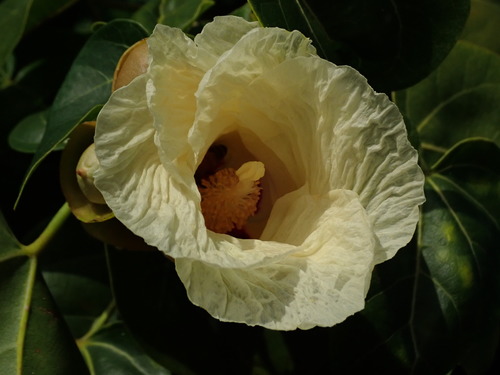
Growing up to 10 to 12 meters tall, the Indian Tulip Tree features a broad, spreading crown densely packed with glossy, heart-shaped leaves that measure 5 to 15 cm long. Its most striking feature is its cup-shaped flowers, which emerge a bright primrose yellow with a dark red throat, only to fade to a dusky pink, orange-bronze, and finally purple by day's end. The fruit is a flattened, globose woody capsule about 3 cm wide containing small, fuzzy seeds.
Categoría
PlantasRareza
Common
Peligro
1/5 · Muy bajo
Snaps
¡Sé la primera persona en hacer un snap!
In Hawaii, the wood of this tree is known as 'milo' and was traditionally used by royalty to carve elegant food bowls because the wood does not impart a bad taste.
Its buoyant seed pods can float in highly saline ocean water for months without losing seed viability.
The flowers undergo a striking color change, blooming yellow in the morning and turning reddish-purple by evening.
Possesses specialized physiological mechanisms to tolerate extreme salinity, allowing it to thrive when splashed by seawater.
Produces lightweight, air-filled seed capsules that float effortlessly on ocean currents, enabling long-distance oceanic dispersal.
Develops an extensive, resilient root system that binds loose sandy soil and protects coastlines from heavy wave erosion.
As a photoautotroph, this tree produces its own organic compounds using sunlight, water, carbon dioxide, and essential nutrients absorbed from the soil.
Dysdercus cingulatus
Feeds on the seeds and sap of the tree, utilizing it as a primary host.
Apis mellifera
Visits the vibrant flowers to collect nectar and pollen, acting as an effective pollinator.
Rhizophora mangle
Competes for light, space, and root space along muddy, tropical estuarine shorelines.
Aún no hay insignias de rasgos asignadas a este objeto.
Todavía no hay alias listados.
Las colecciones para este objeto aparecerán aquí a medida que se añadan más temas.
Peligro
1/5 · Muy bajo
Todavía no hay notas especiales de seguridad.
La forma más fácil de identificar a Indian Tulip Tree es usar la aplicación de identificación de naturaleza Snappit.
500-1500 cm
20-80 años
As a photoautotroph, this tree produces its own organic compounds using sunlight, water, carbon dioxide, and essential nutrients absorbed from the soil.
Found in tropical coastal strand environments, mangrove edges, sandy beaches, and estuarine shores.
Acércate para separar los grupos y explorar dónde se ha fotografiado este objeto.
Los snaps recientes aparecerán aquí a medida que se añadan nuevas observaciones.