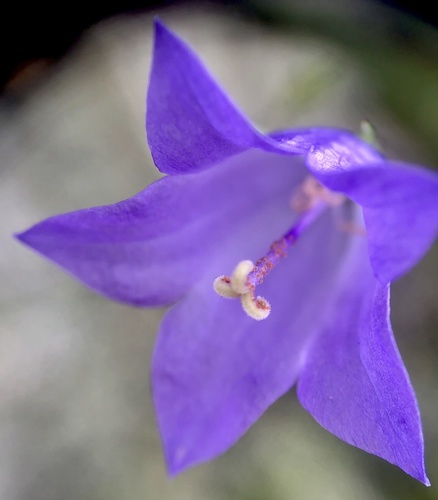


Intermediate Bellflower
campanula intercedens
The Intermediate Bellflower (Campanula intercedens) is a captivating perennial herb that brings a touch of delicate beauty to some of the most rugged landscapes of North America. Commonly found nestled in rocky crevices, sandy shores, and limestone cliffs, this plant is celebrated for its papery, nodding blue-to-violet blossoms that resemble miniature hanging bells. Despite its fragile appearance, the Intermediate Bellflower is remarkably resilient, possessing a tough root system that anchors it securely into sheer rock faces where few other plants can survive. Historically treated as a distinct North American species or as a variety of the widespread Harebell, this wildflower plays a vital role in its local ecosystems by providing nectar to native pollinators and helping to stabilize thin, gravelly soils.
Hábitat: Typically found clinging to rocky crevices, sandy shores, limestone cliffs, and gravelly slopes.
This slender perennial stands between 10 to 40 centimeters tall, supported by thin, wiry stems. Its most distinguishing feature is the cluster of nodding, bell-shaped flowers, which range in color from pale lavender-blue to deep violet, each ending in five pointed lobes. While the lower basal leaves are rounded and heart-shaped, they typically wither before flowering, leaving only narrow, linear leaves along the upper stem.
Categoría
PlantasRareza
Common
Peligro
1/5 · Muy bajo
Snaps
¡Sé la primera persona en hacer un snap!
Its delicate stem is surprisingly flexible and tough, allowing the flower to withstand strong shoreline winds without breaking.
The nodding orientation of the bellflower forces bees to hang upside down to feed, a task native bumblebees are specialized to perform.
The round basal leaves that give the Harebell family its 'rotundifolia' name usually disappear completely by the time the flower blooms.
Utilizes a deep taproot and creeping rhizomes to secure itself in barren, rocky cracks while absorbing limited moisture.
Its downward-facing, bell-like blossoms shield delicate reproductive organs and pollen from rain and wind.
Develops broad basal leaves for early season light capture, transitioning to narrow stem leaves to minimize water loss in summer.
As a photoautotrophic plant, it produces its own food using sunlight, carbon dioxide, and water through photosynthesis.
Bombus impatiens
Provides rich nectar and pollen for foraging bumblebees.
Odocoileus virginianus
Leaves and stems are occasionally grazed by herbivorous mammals.
Danaus plexippus
Visits the blossoms to collect nectar and assist in cross-pollination.
Aún no hay insignias de rasgos asignadas a este objeto.
Todavía no hay alias listados.
Las colecciones para este objeto aparecerán aquí a medida que se añadan más temas.
Peligro
1/5 · Muy bajo
Todavía no hay notas especiales de seguridad.
La forma más fácil de identificar a Intermediate Bellflower es usar la aplicación de identificación de naturaleza Snappit.
10-40 cm
0.01-0.05 kg
3-10 años
As a photoautotrophic plant, it produces its own food using sunlight, carbon dioxide, and water through photosynthesis.
Typically found clinging to rocky crevices, sandy shores, limestone cliffs, and gravelly slopes.
Acércate para separar los grupos y explorar dónde se ha fotografiado este objeto.
Los snaps recientes aparecerán aquí a medida que se añadan nuevas observaciones.

Wisconsin, US
Puedes ver Green Comet Milkweed, Lirio De Bosque y Flowering Spurge.
Ver guía →

Wisconsin, US
Puedes ver Cedro Rojo Oriental, Polipodio De Virginia y Buitre.
Ver guía →

Maine, US
Puedes ver Pino De Banks, Arándano Rojo y Laurel De Oveja.
Ver guía →















