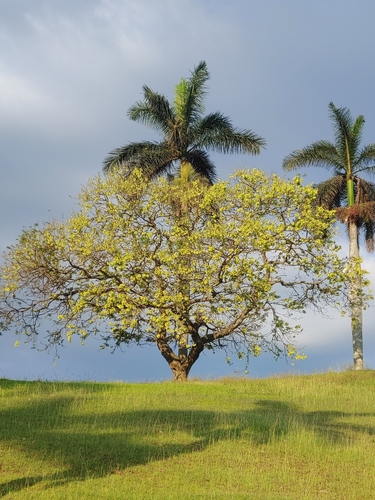


Jamaican Dogwood
piscidia piscipula
The Jamaican Dogwood, also known as the Florida fishpoison tree, is a hardy tropical tree belonging to the legume family. Reaching modest heights, this tree is famous for its historical and cultural role as a natural fishing aid. Indigenous peoples throughout its range discovered that crushing its bark, leaves, and twigs and tossing them into quiet waters would temporarily stun fish, allowing for an effortless harvest without ruining the meat. Beyond this fascinating chemical defense, the tree is highly valued for its incredibly durable, rot-resistant wood, which has been utilized for boat building and fence posts. During the spring, it erupts in beautiful clusters of pea-like, fragrant flowers, making it a beloved sight in dry, coastal woodlands.
Hábitat: Found in dry, rocky soils, coastal hammocks, pine rocklands, and sandy coastal scrub environments.
This medium-sized tree features a short trunk with an irregular, spreading crown and thin, gray-brown bark that breaks into scaly plates on mature trees. The compound leaves are arranged alternately, each consisting of 7 to 11 oval leaflets with a dull green top and a lighter, fuzzy underside. In spring, before the new leaves fully emerge, the tree produces dense clusters of white, pink, or lavender pea-like flowers. These are followed by distinctive, straw-colored seed pods that are uniquely adorned with four papery, wavy wings, measuring up to 10 centimeters in length.
Categoría
PlantasRareza
Common
Peligro
1/5 · Muy bajo
Snaps
¡Sé la primera persona en hacer un snap!
Despite its toxic effects on fish and dogs, the bark has been used in traditional herbal medicine as a sedative and analgesic for humans.
The chemical rotenone found in this tree is still used today as a biodegradable pesticide and to manage fish populations in controlled habitats.
The genus name Piscidia translates directly from Latin as fish killer, referencing its historical use as a piscicide.
Produces rotenone and other toxic compounds in its bark and roots that stun fish by interfering with their oxygen uptake.
Houses symbiotic rhizobia bacteria in its root nodules, allowing it to convert atmospheric nitrogen into a usable nutrient.
Produces four-winged seed pods that catch the wind easily, allowing seeds to glide far from the parent tree.
As a photoautotrophic plant, it produces its own food through photosynthesis using sunlight, carbon dioxide, and water.
Leptotes cassius
Larvae feed on the foliage of the Jamaican Dogwood.
Odocoileus virginianus clavium
Feeds on the leaves, twigs, and young saplings.
Apis mellifera
Pollinates the spring flowers in exchange for nectar.
Aún no hay insignias de rasgos asignadas a este objeto.
Todavía no hay alias listados.
Las colecciones para este objeto aparecerán aquí a medida que se añadan más temas.
Peligro
1/5 · Muy bajo
Todavía no hay notas especiales de seguridad.
La forma más fácil de identificar a Jamaican Dogwood es usar la aplicación de identificación de naturaleza Snappit.
600-1500 cm
50-150 años
As a photoautotrophic plant, it produces its own food through photosynthesis using sunlight, carbon dioxide, and water.
Found in dry, rocky soils, coastal hammocks, pine rocklands, and sandy coastal scrub environments.
Acércate para separar los grupos y explorar dónde se ha fotografiado este objeto.
Los snaps recientes aparecerán aquí a medida que se añadan nuevas observaciones.



_(8616886668).jpg&width=800)











