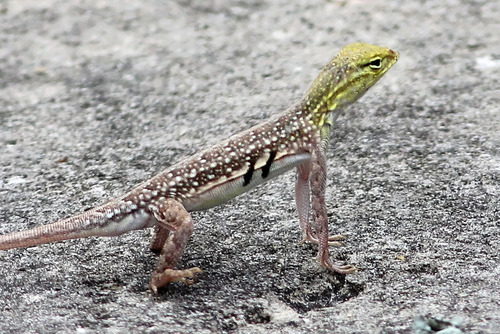


Keeled Earless Lizard
holbrookia propinqua
The Keeled Earless Lizard (Holbrookia propinqua) is a small, highly adapted reptile native to the sandy coastal barrier islands of southern Texas and northeastern Mexico. True to its name, this fascinating creature lacks external ear openings—an evolutionary adaptation that prevents abrasive sand particles from entering its auditory system as it scurries across and burrows into dunes. This lively lizard is a master of thermoregulation, frequently seen basking on warm sands or darting with extreme speed to catch small insects. Despite its abundance in localized sandy areas, its specialized reliance on undisturbed dune systems makes it highly sensitive to coastal development and habitat fragmentation.
Hábitat: Found in coastal sand dunes, sandy beaches, and sparsely vegetated barrier islands along the Gulf of Mexico.
This small lizard typically measures 10 to 14 centimeters in total length, featuring a flattened body with highly keeled scales that give it a rough, matte appearance. Its dorsal coloration is sandy gray, tan, or light brown, decorated with small, pale spots and subtle dark chevrons that mimic the texture of coastal sands. The underside is white or cream. During the breeding season, males display striking sexual dimorphism, developing bright yellow, peach, or blue-green highlights along their flanks, while gravid females exhibit vivid pink or orange coloration on their sides.
Categoría
ReptilesRareza
Common
Peligro
1/5 · Muy bajo
Snaps
¡Sé la primera persona en hacer un snap!
Despite being called 'earless', they can hear perfectly well through sound vibrations transmitted through their jawbone and skull.
During courtship, males perform a series of rapid head-bobs and push-ups to flash their bright blue and yellow flank markings at females.
Their keeled scales are specially structured to reduce glare, allowing them to remain virtually invisible against the glittering sand grains.
When threatened, this lizard quickly dives nose-first into loose sand and shakes its body vigorously to bury itself in seconds, completely hiding from predators.
By lacking external ear openings entirely, this species is uniquely protected against clogging and physical damage from abrasive blowing sand and grit.
It can tolerate exceptionally high sand temperatures by utilizing specialized blood vessels near its head to cool its brain while basking in direct sunlight.
They are active insectivores, constantly foraging along dune slopes and beach debris to catch small crawling and flying arthropods.
Pogonomyrmex barbatus
Often preys on harvester ants as a substantial portion of its daily diet.
Sceloporus variabilis
Frequents the same sandy areas and competes for small insect prey.
Masticophis flagellum
Acts as a swift predator that actively hunts these lizards in dune environments.
Aún no hay insignias de rasgos asignadas a este objeto.
Todavía no hay alias listados.
Las colecciones para este objeto aparecerán aquí a medida que se añadan más temas.
Peligro
1/5 · Muy bajo
Todavía no hay notas especiales de seguridad.
La forma más fácil de identificar a Keeled Earless Lizard es usar la aplicación de identificación de naturaleza Snappit.
10+ cm
0.003+ kg
2+ años
15 km/h
They are active insectivores, constantly foraging along dune slopes and beach debris to catch small crawling and flying arthropods.
Found in coastal sand dunes, sandy beaches, and sparsely vegetated barrier islands along the Gulf of Mexico.
Foraging
Acércate para separar los grupos y explorar dónde se ha fotografiado este objeto.
Los snaps recientes aparecerán aquí a medida que se añadan nuevas observaciones.


















