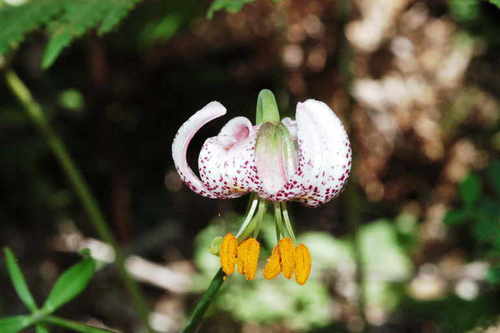


Kellogg'S Lily
lilium kelloggii
The Kellogg's Lily (Lilium kelloggii) is a striking and elegant perennial native to the moist, shady forests of northwestern California and southwestern Oregon. Renowned for its exquisite beauty and intoxicating fragrance, this lily is a true jewel of its habitat. Growing from a scaly, deep-seated bulb, it sends up a tall, slender stem adorned with distinctive whorled leaves, culminating in a spectacular display of nodding, recurved flowers. Its captivating appearance and sweet perfume make it a highly sought-after species by botanists and nature enthusiasts alike, embodying the delicate yet resilient charm of the Pacific Northwest flora.
Hábitat: Found on moist, well-drained slopes within redwood forests, mixed evergreen forests, and chaparral communities, often in partial shade at moderate elevations.
Kellogg's Lily is characterized by its tall stature, typically reaching heights of 60 to 150 centimeters. The leaves are arranged in distinctive whorls around the stem, often with scattered leaves above. Its most identifying feature is the flower, which boasts strongly recurved petals that curl backward, revealing the prominent stamens. The flowers are generally white to pinkish-purple, often adorned with numerous small, dark purple or reddish-brown spots and a yellowish-green stripe down the center of each petal, creating a visually intricate pattern.
Categoría
PlantasRareza
Common
Peligro
1/5 · Muy bajo
Snaps
¡Sé la primera persona en hacer un snap!
Kellogg's Lily is particularly prized by gardeners and collectors for its intense fragrance and unique flower form, though it can be challenging to cultivate outside its specific native conditions.
The bulbs of Kellogg's Lily were traditionally consumed by indigenous peoples of its native range, cooked or baked for their starchy content.
This lily was named in honor of Dr. Albert Kellogg, a prominent physician and botanist who was one of California's first resident botanists.
Unlike many lilies with outward-facing flowers, the strongly recurved petals of Lilium kelloggii create an almost 'turban-like' appearance.
The flowers emit a strong, sweet, and pleasing fragrance, especially noticeable in the evening, which serves to attract specific nocturnal pollinators such as moths.
Its uniquely recurved petals curl back tightly, creating an open and accessible structure that effectively showcases its stamens and nectaries, guiding pollinators to the reproductive parts.
Growing from a deep-seated, scaly bulb provides a natural defense mechanism, allowing the plant to store nutrients and survive periods of drought or minor surface fires.
As an autotrophic plant, Kellogg's Lily produces its own food through photosynthesis, utilizing sunlight, water, and carbon dioxide. It absorbs essential mineral nutrients from the soil via its root system.
Manduca sexta
Moths are attracted to the strong fragrance and often pollinate the flowers.
Odocoileus hemionus columbianus
Deer and other herbivores may browse on the foliage and flowers.
Monadenia fidelis
Slugs and snails can consume leaves and petals, especially on younger plants.
Various species
Mycorrhizal fungi form a symbiotic relationship with the lily's roots, aiding in nutrient absorption.
Aún no hay insignias de rasgos asignadas a este objeto.
Todavía no hay alias listados.
Las colecciones para este objeto aparecerán aquí a medida que se añadan más temas.
Peligro
1/5 · Muy bajo
Todavía no hay notas especiales de seguridad.
La forma más fácil de identificar a Kellogg'S Lily es usar la aplicación de identificación de naturaleza Snappit.
60-150 cm
0.1-0.5 kg
5-15 años
As an autotrophic plant, Kellogg's Lily produces its own food through photosynthesis, utilizing sunlight, water, and carbon dioxide. It absorbs essential mineral nutrients from the soil via its root system.
Found on moist, well-drained slopes within redwood forests, mixed evergreen forests, and chaparral communities, often in partial shade at moderate elevations.
Absorption
50-200
Acércate para separar los grupos y explorar dónde se ha fotografiado este objeto.
Los snaps recientes aparecerán aquí a medida que se añadan nuevas observaciones.









.jpg&width=800)

