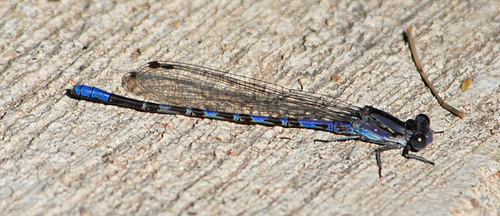


Kiowa Dancer
argia immunda
The Kiowa Dancer (Argia immunda) is a vibrant and active insect belonging to the pond damselfly family. Famous for the bouncy, jerky flight pattern that gives the 'dancer' genus its name, this energetic insect is a staple of rocky streams and rivers in the southwestern United States and Mexico. Unlike many damselflies that prefer to rest among tall reeds, the Kiowa Dancer is often spotted basking flat on sun-warmed rocks or bare patches of earth near the water's edge. They serve as excellent indicators of ecosystem health, flourishing in areas with clean, flowing water. Both fierce predators and vital prey, Kiowa Dancers play a crucial role in controlling local populations of mosquitoes and midges, making them a welcome sight for hikers and nature enthusiasts.
Hábitat: Typically found along the sunlit margins of rocky streams, small rivers, and clear creeks, often perching directly on boulders or exposed soil near the water.
Male Kiowa Dancers are striking insects, displaying a bright violet or vivid blue thorax marked with bold black shoulder stripes. Their abdomens are primarily blue or violet with distinct black rings and dorsal markings that become more prominent towards the tip. Females are much more cryptically colored, typically exhibiting subdued pale brown or tan tones with similar, though fainter, dark patterning to help them blend into their surroundings. Both sexes possess large, widely spaced eyes and clear, heavily veined wings that they fold together over their back when at rest. They are small and slender, usually measuring between 3 to 4 centimeters in total length.
Categoría
InsectosRareza
Common
Peligro
1/5 · Muy bajo
Snaps
¡Sé la primera persona en hacer un snap!
Before becoming graceful, flying adults, Kiowa Dancers spend most of their lives underwater as predatory nymphs, breathing through leaf-like gills at the end of their abdomens.
The common name Dancer comes from the genus's characteristic jerky, bouncing flight, which looks like an erratic aerial dance.
Unlike most other types of damselflies that cling to vertical plant stems, Dancers strongly prefer to perch flat on the ground or on rocks.
When resting, damselflies like the Kiowa Dancer fold their wings tightly over their backs, unlike dragonflies which keep their wings spread out horizontally.
Males remain physically attached to the female's prothorax while she lays eggs in vegetation or wood, guarding her from rival males.
They utilize a distinct, erratic, bouncing flight style that makes them harder for avian predators to track and catch on the wing.
Their large, widely spaced compound eyes provide nearly 360-degree vision, allowing them to spot both tiny prey and incoming threats with remarkable precision.
Both adults and aquatic nymphs are voracious predators, feeding on a wide variety of smaller insects and invertebrates.
Diferencias por edad: Nymphs are aquatic ambush predators feeding on water-dwelling invertebrates, whereas adults are aerial hunters catching flying insects.
Culex quinquefasciatus
Adult Kiowa Dancers catch and consume large quantities of adult mosquitoes on the wing.
Sayornis phoebe
Riparian birds frequently prey on resting and flying damselflies along streams.
Argia moesta
Shares habitat and competes for perching spots and prey with similar damselfly species.
Aún no hay insignias de rasgos asignadas a este objeto.
Todavía no hay alias listados.
Las colecciones para este objeto aparecerán aquí a medida que se añadan más temas.
Peligro
1/5 · Muy bajo
Todavía no hay notas especiales de seguridad.
La forma más fácil de identificar a Kiowa Dancer es usar la aplicación de identificación de naturaleza Snappit.
3-4 cm
3-5 cm
0.0001-0.0003 kg
0-1 años
15 km/h
Both adults and aquatic nymphs are voracious predators, feeding on a wide variety of smaller insects and invertebrates.
Typically found along the sunlit margins of rocky streams, small rivers, and clear creeks, often perching directly on boulders or exposed soil near the water.
Acércate para separar los grupos y explorar dónde se ha fotografiado este objeto.
Los snaps recientes aparecerán aquí a medida que se añadan nuevas observaciones.















