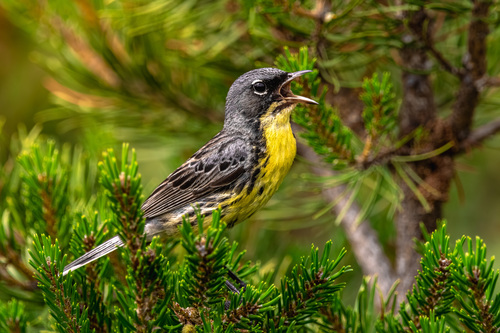


Kirtland'S Warbler
setophaga kirtlandii
Kirtland's Warbler (Setophaga kirtlandii) is a charismatic songbird celebrated as one of North America's rarest wood-warblers. This small, energetic avian specialist is famously selective about its nesting habitat, breeding almost exclusively in young, dense jack pine forests of northern Michigan, Wisconsin, and Ontario. Historically threatened by severe habitat loss and brood parasitism, intensive conservation partnerships have successfully pulled this beautiful bird back from the brink of extinction. Known for its striking yellow and gray plumage and distinctive tail-wagging behavior, Kirtland's Warbler is a favorite among birdwatchers who travel from all over the world to catch a glimpse of this elusive species. Its loud, melodious song rings out through the jack pine barrens during the spring breeding season, signaling a triumphant return from its wintering grounds in the Bahamas.
Hábitat: Found in young, dense stands of jack pine growing on sandy soils, specifically trees between 5 and 20 years old and 1.5 to 5 meters in height.
Kirtland's Warbler is a relatively large, robust warbler, measuring around 14 to 15 centimeters in length. It features a bluish-gray head and back with dark black streaks down its mantle. Its most striking feature is a bright lemon-yellow breast and belly, highlighted by delicate black speckles or streaks along its flanks. A prominent, broken white eye-ring circles each dark eye, giving it an alert, wide-eyed expression. Females and immature birds share a similar pattern but exhibit duller, slightly brownish-gray upperparts.
Categoría
AvesRareza
Common
Peligro
1/5 · Muy bajo
Snaps
¡Sé la primera persona en hacer un snap!
Because they nest strictly on the ground, their eggs and fledglings are highly vulnerable to terrestrial predators like garter snakes and chipmunks.
The cones of the jack pine tree require the intense heat of fire to open and release seeds, meaning the Kirtland's Warbler's survival is historically completely dependent on forest fires.
The species was named after Jared P. Kirtland, an Ohio physician and naturalist, after a specimen was collected on his farm in 1851.
It relies entirely on fire-dependent jack pine ecosystems, nesting only where recent wildfires or managed burns have stimulated new pine growth.
It exhibits a near-continuous tail-wagging behavior, pumping its tail up and down while foraging to flush out insects and communicate.
Males possess an exceptionally loud, rich, bubbling song that can carry over a quarter-mile through dense pine boughs.
Primarily feeds on insects and other arthropods during the breeding season, supplementing its diet with berries and nectar during the winter.
Diferencias por edad: Nestlings are fed exclusively soft-bodied insects like caterpillars and sawfly larvae, while adults consume harder-shelled insects and seasonal berries.
Pinus banksiana
Relies on this tree species exclusively for breeding, nesting on the ground under its low-hanging, protective lower branches.
Molothrus ater
A severe brood parasite that lays its eggs in the warbler's nests, often causing the warbler parents to raise the cowbird chick at the expense of their own.
Cyanocitta cristata
An opportunistic predator known to raid ground nests to consume eggs and vulnerable nestlings.
Aún no hay insignias de rasgos asignadas a este objeto.
Todavía no hay alias listados.
Las colecciones para este objeto aparecerán aquí a medida que se añadan más temas.
Peligro
1/5 · Muy bajo
Todavía no hay notas especiales de seguridad.
La forma más fácil de identificar a Kirtland'S Warbler es usar la aplicación de identificación de naturaleza Snappit.
14-15 cm
22-24 cm
0.012-0.016 kg
4-9 años
40 km/h
Primarily feeds on insects and other arthropods during the breeding season, supplementing its diet with berries and nectar during the winter.
Found in young, dense stands of jack pine growing on sandy soils, specifically trees between 5 and 20 years old and 1.5 to 5 meters in height.
Acércate para separar los grupos y explorar dónde se ha fotografiado este objeto.
Los snaps recientes aparecerán aquí a medida que se añadan nuevas observaciones.




.jpg&width=800)