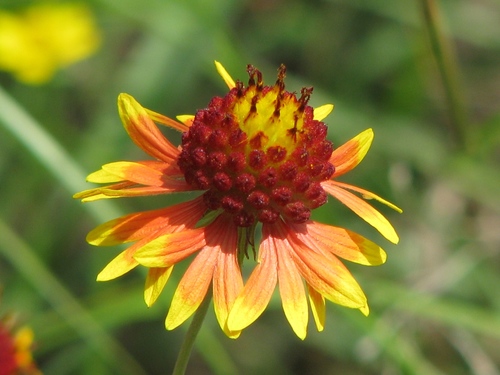


Lanceleaf Blanketflower
gaillardia aestivalis
The Lanceleaf Blanketflower is a resilient and beautiful native wildflower of the southeastern and south-central United States, belonging to the sunflower family. It brings vibrant bursts of color to dry, sandy soils where many other plants struggle to survive. This tough perennial or biennial herb plays a critical role in local ecosystems by supporting a diverse range of native pollinators. Its daisy-like flowers, which bloom throughout the hot summer months, display a stunning array of colors ranging from bright yellow and orange to deep purplish-red.
Hábitat: Typically found in open, dry areas with sandy soils, including pine flatwoods, sandhills, roadsides, and coastal dunes.
Growing up to 60 cm tall, this plant features narrow, lance-shaped leaves that are alternately arranged along dry, hairy stems. Its solitary flower heads measure about 3 to 5 cm across, showcasing a prominent dome of dark purple or brownish-red disc florets in the center. The outer ray florets can vary, often tipped in bright yellow with purplish-pink bases, or occasionally presenting as entirely yellow or solid dark pink.
Categoría
PlantasRareza
Common
Peligro
1/5 · Muy bajo
Snaps
¡Sé la primera persona en hacer un snap!
The name 'Blanketflower' is thought to refer to the flowers' resemblance to the brightly colored woven blankets handcrafted by Native American tribes.
This species is highly variable in appearance, with some populations having entirely yellow flowers and others displaying deep, solid reddish-purple heads.
Unlike many garden varieties of Gaillardia which are hybrids, Gaillardia aestivalis is a true native wildflower crucial for preserving regional biodiversity.
Developed deep taproots and narrow, hairy leaves that minimize water loss, allowing it to thrive in arid, nutrient-poor sandy soils.
Produces abundant nectar and pollen over a prolonged summer blooming period, attracting dozens of species of bees, butterflies, and beetles.
Adapted to fire-prone ecosystems like longleaf pine savannas, rapidly regenerating from its rootstock or seed bank after a burn.
As an autotrophic plant, it produces its own food through photosynthesis, utilizing sunlight, carbon dioxide, and water while absorbing essential nutrients through its roots.
Apis mellifera
Feeds on nectar and pollen, acting as a primary pollinator.
Bombus pensylvanicus
Feeds on nectar and assists in cross-pollination in pine flatwood habitats.
Gopherus polyphemus
Feeds on the leaves and flowers of low-growing plants in sandy habitats.
Aún no hay insignias de rasgos asignadas a este objeto.
Todavía no hay alias listados.
Las colecciones para este objeto aparecerán aquí a medida que se añadan más temas.
Peligro
1/5 · Muy bajo
Todavía no hay notas especiales de seguridad.
La forma más fácil de identificar a Lanceleaf Blanketflower es usar la aplicación de identificación de naturaleza Snappit.
30-60 cm
1-3 años
As an autotrophic plant, it produces its own food through photosynthesis, utilizing sunlight, carbon dioxide, and water while absorbing essential nutrients through its roots.
Typically found in open, dry areas with sandy soils, including pine flatwoods, sandhills, roadsides, and coastal dunes.
Acércate para separar los grupos y explorar dónde se ha fotografiado este objeto.
Los snaps recientes aparecerán aquí a medida que se añadan nuevas observaciones.