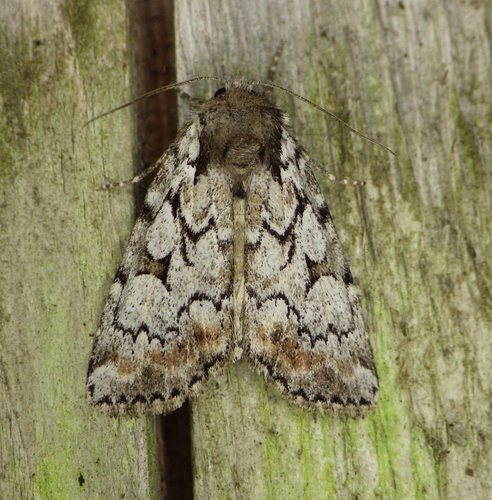


Large-Spotted Dart
aplectoides condita
The Large-Spotted Dart (Aplectoides condita) is a fascinating nocturnal moth native to the northern conifer and boreal forests of North America. Renowned for its intricate wing patterns, this insect plays an important role in its forest ecosystems, acting as both a herbivorous consumer in its larval stage and a vital food source for nocturnal insectivores as an adult. Highly adapted to cooler climates, it successfully navigates the dense, moist undergrowth of bogs and pine barrens.
Hábitat: Typically found in northern boreal forests, mixed coniferous woodlands, and acidic peatlands or bogs.
This moth features a wingspan of approximately 3.5 to 4.2 centimeters. Its forewings are beautifully mottled with shades of charcoal gray, pale white, and subtle brown, highlighted by a characteristic large, pale orbicular spot and a distinct kidney-shaped reniform spot. The hindwings are a more uniform, muted grayish-brown with darker venation, helping the insect blend seamlessly into tree bark and lichen when at rest.
Categoría
InsectosRareza
Common
Peligro
1/5 · Muy bajo
Snaps
¡Sé la primera persona en hacer un snap!
Its species name 'condita' is Latin for 'hidden' or 'secretive', perfectly describing its masterfully camouflaged lifestyle.
Like many owlet moths, they possess hearing organs on their metathorax that can detect the echolocation clicks of insect-eating bats.
The caterpillar mimics the exact color and texture of tamarack twigs, making it highly elusive to foraging birds.
The complex, mottled gray-and-white patterns on its wings allow it to perfectly mimic the appearance of crustose tree lichens, rendering it virtually invisible to diurnal predators.
It possesses the ability to rapidly shiver its thoracic muscles to raise its internal body temperature, allowing it to take flight during chilly northern nights.
Equipped with highly sensitive compound eyes and delicate antennae, it easily navigates dense canopy shadows and locates mate pheromones in pitch blackness.
The larvae feed on the needles of coniferous trees, especially larches, while the adults primarily consume nectar and sap.
Diferencias por edad: Larvae have chewing mouthparts adapted strictly for feeding on tough conifer needles, whereas the adult moths possess a coiled proboscis to sip liquid nutrients.
Larix laricina
The larvae of the Large-Spotted Dart feed extensively on the needles of this coniferous tree.
Poecile atricapillus
This small forest bird actively hunts the adult moths resting on tree bark during the day.
Peromyscus leucopus
This nocturnal rodent searches the forest floor debris for pupating larvae and pupae.
Aún no hay insignias de rasgos asignadas a este objeto.
Todavía no hay alias listados.
Las colecciones para este objeto aparecerán aquí a medida que se añadan más temas.
Peligro
1/5 · Muy bajo
Todavía no hay notas especiales de seguridad.
La forma más fácil de identificar a Large-Spotted Dart es usar la aplicación de identificación de naturaleza Snappit.
1-2 cm
3-4 cm
0.0001-0.0003 kg
1 años
15 km/h
The larvae feed on the needles of coniferous trees, especially larches, while the adults primarily consume nectar and sap.
Typically found in northern boreal forests, mixed coniferous woodlands, and acidic peatlands or bogs.
Acércate para separar los grupos y explorar dónde se ha fotografiado este objeto.
Los snaps recientes aparecerán aquí a medida que se añadan nuevas observaciones.








_(2).JPG&width=800)





