Lazuli Bunting
Passerina amoena
The Lazuli Bunting is a small, colorful bird that loves to sing. Males are bright blue with a warm orange belly, while females are more brown and spotted. They are often found in open fields and gardens.
Hábitat: Open fields and gardens
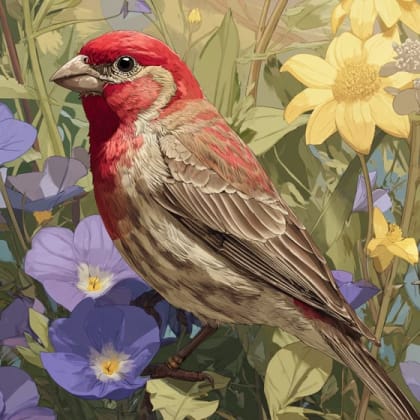
The Lazuli Bunting is a small, vibrant songbird. Males boast a brilliant turquoise-blue head and back, a cinnamon chest, and a white belly. Females are much duller, appearing mostly brown with faint streaking, lacking the male's striking colors.
Categoría
AvesRareza
Common
Peligro
1/5 · Muy bajo
Snaps
¡Sé la primera persona en hacer un snap!
Sometimes, a male Lazuli Bunting will help care for chicks in another pair's nest, even if they aren't his own!
The dazzling blue color on male Lazuli Buntings comes from light-refracting feathers, not blue pigment!
Their name "Lazuli" comes from a deep blue gemstone called lapis lazuli, referencing the male's stunning plumage!
Young male Lazuli Buntings often learn their unique songs by listening to and mimicking nearby adult males.
Lazuli Bunting has unique feather structures that refract light, making their blue color appear incredibly vibrant.
Lazuli Bunting has a strong, cone-shaped beak that helps them crack open tough seeds for food.
Lazuli Bunting can learn complex songs from other males that helps them attract mates and defend territory.
Lazuli Bunting can travel thousands of kilometers during migration, guided by the Earth's magnetic field and stars.
These tiny birds enjoy a diverse diet of small insects during summer and various seeds year-round.

Accipiter striatus
A common avian predator of small birds.
Thamnophis sirtalis
Known to prey on eggs and nestlings.
Felis catus
A significant predator of birds, especially near human settlements.
Malacosoma americanum
Lazuli Buntings feed on various insect larvae, including caterpillars.

Bromus tectorum
They consume seeds from many grass species, including cheatgrass.
Describe a los animales, principalmente aves, que poseen una cubierta de plumas.
Marcado con manchas o parches de un color diferente.
Los animales sociales viven en grupos organizados, cooperando para obtener beneficios de supervivencia como la búsqueda de alimento, la defensa y la cría de descendencia.
Las criaturas aéreas pasan una parte importante de su vida en el aire, utilizando el vuelo para diversas actividades como la caza, la migración o la anidación.

Los animales cantores producen vocalizaciones complejas, a menudo con el propósito de atraer parejas, defender el territorio o comunicarse dentro de su especie.

Colorido describe a organismos u objetos que exhiben una amplia variedad de colores brillantes y distintivos.

Este rasgo identifica a los organismos cuya dieta consiste principalmente en insectos y otros pequeños invertebrados.

Los hábitats de pastizales son biomas terrestres dominados por pastos y plantas herbáceas, que sustentan a una variedad de animales de pastoreo.

Los animales diurnos están activos principalmente durante el día y suelen descansar o dormir por la noche.

Los animales migratorios emprenden movimientos estacionales de una región a otra, típicamente en respuesta a cambios en el clima o la disponibilidad de alimentos.

Esta característica de hábitat indica especies que pueden coexistir con los humanos en entornos urbanos y suburbanos, utilizando estructuras artificiales y espacios verdes.
Todavía no hay alias listados.
Peligro
1/5 · Muy bajo
Enjoy watching birds from a distance and don't try to touch them.
13-15 cm
22-25 cm
0.012-0.018 kg
2-7 años
40 km/h
These tiny birds enjoy a diverse diet of small insects during summer and various seeds year-round.
Open fields and gardens
Foraging
Acércate para separar los grupos y explorar dónde se ha fotografiado este objeto.
Los snaps recientes aparecerán aquí a medida que se añadan nuevas observaciones.