

Leonora'S Dancer
argia leonorae
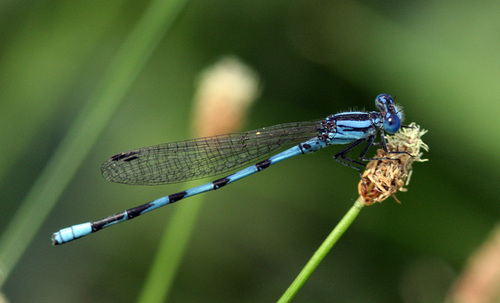
Leonora's Dancer (Argia leonorae) is a slender and striking damselfly belonging to the family Coenagrionidae, commonly known as pond damselflies. Found mainly around slow-flowing spring runs, rocky streams, and seepages, this insect is named for its bouncy, fluttering flight pattern, which resembles a delicate dance over water. While small, Leonora's Dancer plays a vital role in its local riparian ecosystems, serving both as an voracious predator of smaller insects and as a nutritious food source for birds, frogs, and larger aquatic insects.
Hábitat: Typically found near small, spring-fed rocky streams, seepages, and slow-moving rivers in semi-arid and limestone-rich regions.
This moderately sized damselfly features a long, narrow abdomen and clear wings that it folds together over its back when at rest. Males exhibit a vibrant coloration of bright blue and black patterns along the thorax and abdomen tip, whereas females are more subtly colored in muted shades of tan, brown, or dull blue. They possess large, widespread compound eyes on the sides of the head, a total body length of approximately 3.5 to 4.2 centimeters, and a wingspan of 4.0 to 5.0 centimeters.
Categoría
InsectosRareza
Common
Peligro
1/5 · Muy bajo
Snaps
¡Sé la primera persona en hacer un snap!
The genus name 'Argia' is derived from Greek mythology, referring to one of the Oceanids, reflecting their close connection to freshwater streams.
They earn the name 'Dancer' from their distinctive flight style, which is much more erratic and bouncy compared to the direct flight of dragonflies.
Unlike dragonflies, which rest with their wings spread flat, Leonora's Dancers and other damselflies fold their wings neatly over their backs.
Utilizes a highly maneuverable, fluttering flight pattern that allows it to easily navigate dense shoreline vegetation and evade larger aerial predators.
Possesses large, multi-faceted compound eyes that provide nearly 360-degree vision, making it exceptionally skilled at detecting the slightest movement of prey or threats.
During its aquatic nymph stage, it uses a rapid, spring-loaded lower lip called a labium to snatch passing prey in a fraction of a second.
Highly active predator that feeds on a wide range of small insects in the air as an adult, and aquatic invertebrates as a nymph.
Diferencias por edad: Nymphs are aquatic and hunt small freshwater invertebrates like mosquito larvae, whereas adults are aerial hunters targeting flying insects.
Lithobates catesbeianus
Adults and nymphs are preyed upon by frogs living along the stream banks.
Culex pipiens
Adult damselflies catch and consume flying mosquitoes in mid-air over the water.
Sayornis phoebe
This flycatcher hunts damselflies and other riparian insects flying close to the water surface.
Aún no hay insignias de rasgos asignadas a este objeto.
Todavía no hay alias listados.
Las colecciones para este objeto aparecerán aquí a medida que se añadan más temas.
Peligro
1/5 · Muy bajo
Todavía no hay notas especiales de seguridad.
La forma más fácil de identificar a Leonora'S Dancer es usar la aplicación de identificación de naturaleza Snappit.
3+ cm
4+ cm
0+ kg
1+ años
15 km/h
Highly active predator that feeds on a wide range of small insects in the air as an adult, and aquatic invertebrates as a nymph.
Typically found near small, spring-fed rocky streams, seepages, and slow-moving rivers in semi-arid and limestone-rich regions.
Acércate para separar los grupos y explorar dónde se ha fotografiado este objeto.
Los snaps recientes aparecerán aquí a medida que se añadan nuevas observaciones.











.jpg&width=800)





