

Lesser Maple Spanworm Moth
macaria pustularia
The Lesser Maple Spanworm Moth (Macaria pustularia) is a charming and common Geometrid moth native to eastern North America. Named for its caterpillars' favorite food and their characteristic "looping" crawl, this delicate white moth is a frequent visitor to deciduous forests and suburban yards alike. During the summer, it plays an important role in the local ecosystem, serving as a vital food source for nesting birds and acting as a key indicator of forest health. Though small, its abundance makes it a staple of North American woodlands.
Hábitat: Found primarily in deciduous and mixed forests, particularly where maple trees are abundant, as well as in wooded suburban parks and gardens.
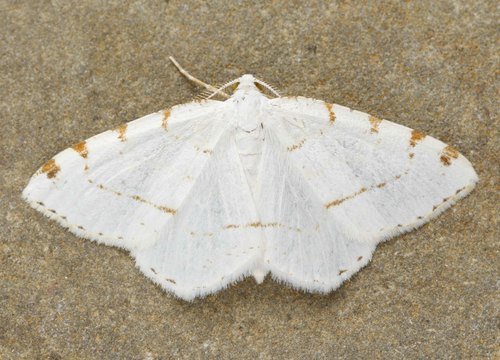
Adults are small, delicate moths with a wingspan of 2 to 3 cm. Their wings are mostly pure, chalky white to light cream, decorated with three distinct orange-yellow or light brownish transverse lines crossing the forewings. A notable diagnostic feature is a tiny, bright orange or brownish spot or smudge located near the middle of the forewing's outer margin. When resting, they hold their wings flat against the surface, showcasing their triangular profile and hiding their light-colored legs beneath.
Categoría
InsectosRareza
Common
Peligro
1/5 · Muy bajo
Snaps
¡Sé la primera persona en hacer un snap!
Despite their small size, their caterpillars can occasionally experience massive population booms, temporarily defoliating small stands of maples.
The common name 'spanworm' comes from the caterpillar's unique walking pattern, which makes it look as though it is measuring the earth inch by inch.
They are highly attracted to ultraviolet light sources, making them a common subject for backyard moth-watching setups.
The caterpillar lacks middle prolegs, forcing it to draw its rear up to its front legs to form a loop before extending forward, a highly efficient crawling technique.
When resting on birch or light-colored tree trunks, the flat, white-and-orange wings of the adult moth blend seamlessly with the bark patterns to avoid detection.
Caterpillars selectively feed on maple leaves with lower tannin levels, maximizing nutrient absorption while minimizing defensive chemical intake.
Caterpillars feed on the foliage of deciduous trees, specifically maples, while adult moths rarely feed, occasionally sipping nectar.
Diferencias por edad: Caterpillars feed continuously on leaves, whereas adult moths have reduced mouthparts and feed minimally or not at all.
Acer rubrum
The primary larval host tree where females lay eggs and caterpillars feed on foliage.
Baeolophus bicolor
Birds heavily prey upon the caterpillars and resting adult moths during the summer breeding season.
Cotesia congregationis
A parasitoid wasp that lays eggs inside the caterpillars, controlling their population.
Aún no hay insignias de rasgos asignadas a este objeto.
Todavía no hay alias listados.
Las colecciones para este objeto aparecerán aquí a medida que se añadan más temas.
Peligro
1/5 · Muy bajo
Todavía no hay notas especiales de seguridad.
La forma más fácil de identificar a Lesser Maple Spanworm Moth es usar la aplicación de identificación de naturaleza Snappit.
1-2 cm
2-3 cm
0.0001-0.0003 kg
Caterpillars feed on the foliage of deciduous trees, specifically maples, while adult moths rarely feed, occasionally sipping nectar.
Found primarily in deciduous and mixed forests, particularly where maple trees are abundant, as well as in wooded suburban parks and gardens.
Grazing
50-150
Acércate para separar los grupos y explorar dónde se ha fotografiado este objeto.
Los snaps recientes aparecerán aquí a medida que se añadan nuevas observaciones.