

Lindheimer'S Senna
senna lindheimeriana
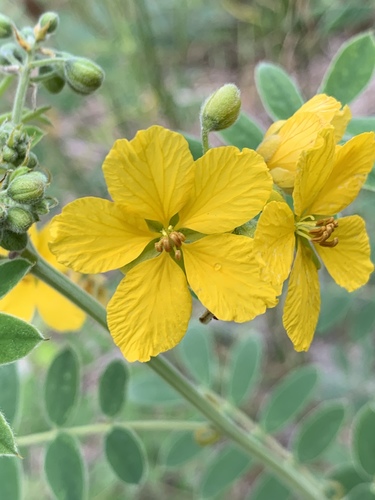
Lindheimer's Senna, also known as velvet leaf senna, is an attractive, upright perennial herb native to the arid and semi-arid regions of the southwestern United States and northern Mexico. Characterized by its soft, velvety gray-green foliage and vibrant clusters of bright yellow flowers, this plant is a resilient survivor in harsh, sun-drenched environments. It plays a critical role in its local ecosystem by providing pollen and nectar to native insects and serving as a host plant for several butterfly species.
Hábitat: Typically found in dry, rocky limestone soils, desert grasslands, canyon floors, and scrublands of the southwestern United States and northern Mexico.
This subshrub typically grows 90 to 150 cm tall, with velvety, pinnately compound leaves featuring 3 to 8 pairs of elliptical leaflets covered in fine, dense hairs that give the plant a silvery-gray sheen. From late summer to autumn, it produces brilliant, five-petaled yellow flowers about 2.5 cm wide in terminal or axillary clusters. These blooms are followed by flattened, slightly curved brown seed pods that are also finely hairy.
Categoría
PlantasRareza
Common
Peligro
1/5 · Muy bajo
Snaps
¡Sé la primera persona en hacer un snap!
Its species name, 'lindheimeriana', honors Ferdinand Lindheimer, who is widely regarded as the father of Texas botany.
The plant's flowers cannot be pollinated by ordinary wind or casual insect visits; they require 'buzz pollination' from large native bees.
The velvety hairs on the leaves feel incredibly soft to the touch, earning it the common nickname 'velvet leaf senna'.
The dense, velvety hairs covering its foliage reflect intense sunlight, reduce wind speed across the leaf surface, and minimize water loss through transpiration.
It features specialized glands at the base of its leaves that secrete sweet nectar to recruit ants, which act as a security force against herbivorous insects.
A deep, sturdy taproot system allows the plant to access moisture far below the surface in parched, rocky limestone soils.
As a photosynthetic plant, it produces its own food using sunlight, carbon dioxide, water, and essential mineral nutrients absorbed from the soil.
Abaeis nicippe
The caterpillars of this butterfly species feed on the foliage of Lindheimer's Senna as their primary food source.
Bombus pensylvanicus
Provides nectar and pollen via specialized buzz pollination where the bee vibrates its flight muscles to release the pollen.
Pogonomyrmex desertorum
Attracted by extrafloral nectaries, these ants patrol the plant and defend it from destructive caterpillars and beetles.
Aún no hay insignias de rasgos asignadas a este objeto.
Todavía no hay alias listados.
Las colecciones para este objeto aparecerán aquí a medida que se añadan más temas.
Peligro
1/5 · Muy bajo
Todavía no hay notas especiales de seguridad.
La forma más fácil de identificar a Lindheimer'S Senna es usar la aplicación de identificación de naturaleza Snappit.
90-150 cm
3-10 años
As a photosynthetic plant, it produces its own food using sunlight, carbon dioxide, water, and essential mineral nutrients absorbed from the soil.
Typically found in dry, rocky limestone soils, desert grasslands, canyon floors, and scrublands of the southwestern United States and northern Mexico.
Photosynthesis
Acércate para separar los grupos y explorar dónde se ha fotografiado este objeto.
Los snaps recientes aparecerán aquí a medida que se añadan nuevas observaciones.

Texas, US
Puedes ver Algodoncillo Cuerno De Antílope y Lindheimer's Senna.
Ver guía →
Texas, US
Puedes ver Bigtooth Maple, Texas Madrone y Scarlet Leather Flower.
Ver guía →

Texas, US
Puedes ver Mariposa Cola De Golondrina De La Aristoloquia.
Ver guía →

Texas, US
Puedes ver Mariposa Cola De Golondrina De La Aristoloquia.
Ver guía →



.jpg&width=800)










