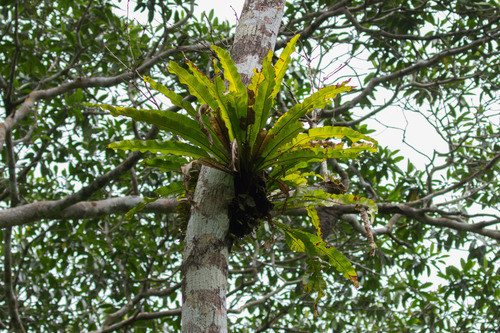


Long Strapfern
campyloneurum phyllitidis
The Long Strapfern (Campyloneurum phyllitidis) is a striking evergreen epiphyte famed for its long, undivided, ribbon-like fronds that can gracefully arch or stand erect. Native to tropical and subtropical regions of the Americas, including southern Florida, the Caribbean, and Central and South America, it primarily grows on the trunks and branches of trees in moist hammocks and cypress swamps. Unlike many delicate, finely-cut ferns, its leather-textured, shiny leaves give it an almost prehistoric appearance. Historically valued as an ornamental specimen, it thrives in warm, humid, shaded environments where it plays a vital role in its forest canopy community. Gathering moisture and nutrients directly from the air and organic debris caught on its roots, it exemplifies the resilience and adaptability of epiphytic life. For hikers and nature enthusiasts, spotting a lush cluster of these strap-shaped ferns cascading from an ancient oak is a hallmark of a healthy, biodiverse woodland ecosystem.
Hábitat: Found in humid, shaded environments such as tropical wet forests, cypress swamps, and hardwood hammocks, where it typically grows as an epiphyte on tree trunks.
This fern is distinguished by its long, strap-shaped, simple leaves (fronds) that are bright green, shiny, and leathery. These fronds typically measure 30 to 100 centimeters in length and feature slightly wavy or entire margins with a distinct, prominent central midrib. The underside of mature leaves displays neat, parallel rows of circular, orange-to-brown spore-bearing structures called sori, which lack an indusium (protective covering). It grows from a short-creeping, scaly rhizome, typically forming dense, cascading clumps on tree trunks or damp rocks.
Categoría
PlantasRareza
Common
Peligro
1/5 · Muy bajo
Snaps
¡Sé la primera persona en hacer un snap!
Because it is an epiphyte and not a parasite, it lives entirely on the moisture and nutrients it captures from the air and rain, doing zero harm to its host tree.
The scientific genus name Campyloneurum comes from the Greek words meaning 'curved nerve,' referring to the beautifully arched veins on its fronds.
Unlike many classic ferns, its leaves are completely undivided, making them look more like green ribbons than typical fern fronds.
Utilizes a dense, scaly rhizome and roots to anchor securely to tree bark without extracting nutrients from the host tree, capturing moisture and dust from the air instead.
The thick, leathery texture of its strap-like leaves minimizes water loss through transpiration, allowing it to withstand brief periods of dry weather high in the canopy.
Produces thousands of tiny spores housed in unprotected sori on the underside of its leaves, which are easily caught and carried by the wind to colonize new trees.
As a photosynthetic plant, it generates its own energy from sunlight, carbon dioxide, and water, supplemented by dissolved nutrients collected by its roots from decaying bark debris.
Quercus virginiana
Serves as a common host tree providing structural support for the epiphytic fern in southern hammock ecosystems.
Taxodium distichum
Provides a damp, elevated substrate for the fern to grow above wet swamp floors in cypress domes.
Aún no hay insignias de rasgos asignadas a este objeto.
Todavía no hay alias listados.
Las colecciones para este objeto aparecerán aquí a medida que se añadan más temas.
Peligro
1/5 · Muy bajo
Todavía no hay notas especiales de seguridad.
La forma más fácil de identificar a Long Strapfern es usar la aplicación de identificación de naturaleza Snappit.
30+ cm
5+ años
As a photosynthetic plant, it generates its own energy from sunlight, carbon dioxide, and water, supplemented by dissolved nutrients collected by its roots from decaying bark debris.
Found in humid, shaded environments such as tropical wet forests, cypress swamps, and hardwood hammocks, where it typically grows as an epiphyte on tree trunks.
Acércate para separar los grupos y explorar dónde se ha fotografiado este objeto.
Los snaps recientes aparecerán aquí a medida que se añadan nuevas observaciones.


















_(49869833552).jpg&width=800)


