

Lowland Brittle Fern
cystopteris protrusa
The Lowland Brittle Fern (Cystopteris protrusa) is a delicate, bright green fern native to the rich, moist deciduous forests of eastern North America. Unlike many of its rock-dwelling relatives, this elegant species prefers the soft, organic soils of alluvial plains, stream banks, and shaded slopes. It is highly recognized for its early spring emergence, bringing fresh, vibrant green hues to the forest floor long before many other forest plants have fully awoken. Its common name, 'brittle fern,' stems from the fragile nature of its stems, which easily snap when disturbed. What makes the Lowland Brittle Fern particularly fascinating to botanists is its specialized rhizome growth. The underground stem creeps forward horizontally, protruding well beyond the active fronds of the current season. This creeping habit allows the fern to quickly colonize optimal micro-habitats in dynamic floodplain environments, making it a resilient and widespread member of the woodland understory.
Hábitat: Typically found in rich, moist, deciduous woodlands, floodplain forests, and along shaded stream banks in alluvial soil.
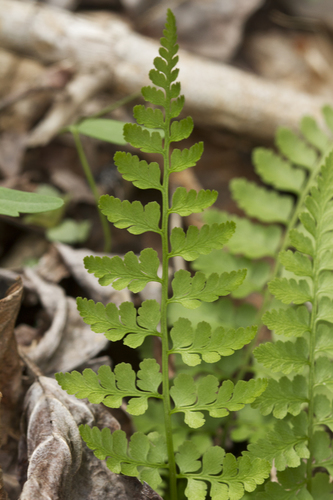
This small fern typically stands between 15 to 40 centimeters tall, featuring lance-shaped, delicate light-green fronds. The fronds are bipinnate-pinnatifid, meaning they are twice-divided with deeply lobed leaflets, creating a feathery and lacy appearance. The stipes, or leaf stalks, are notably fragile, slender, and range in color from a pale straw-yellow to translucent green. A key identifying feature is its long, creeping rhizome, which protrudes 1 to 5 centimeters past the attachment point of the youngest frond and is covered in small, pale brown scales.
Categoría
PlantasRareza
Common
Peligro
1/5 · Muy bajo
Snaps
¡Sé la primera persona en hacer un snap!
The specific epithet 'protrusa' refers to the plant's creeping rhizomes, which uniquely protrude several centimeters beyond the current season's fronds.
This plant is one of the earliest ferns to emerge and mature in spring, often producing spores and yellowing before summer heat intensifies.
Unlike many of its close relatives in the Cystopteris genus that grow in rocky crevices, this species is specialized for growing directly in soil.
The underground rhizome grows rapidly forward, protruding past active fronds to efficiently colonize shifting, nutrient-rich alluvial soils.
It emerges early in spring, completing its growth and spore dispersal before the dense forest canopy blocks out crucial sunlight.
Its brittle stems snap easily under animal trampling, preventing structural damage to the vital underground rhizome system.
As a photosynthetic plant, the lowland brittle fern manufactures its own sugars using sunlight, water, and carbon dioxide.
Acer saccharum
Provides the dense canopy and shade required to maintain the cool, moist understory microclimate this fern needs.
Arion subfuscus
Feeds on the delicate, low-lying fronds of the fern during the damp spring and summer months.
Aún no hay insignias de rasgos asignadas a este objeto.
Todavía no hay alias listados.
Las colecciones para este objeto aparecerán aquí a medida que se añadan más temas.
Peligro
1/5 · Muy bajo
Todavía no hay notas especiales de seguridad.
La forma más fácil de identificar a Lowland Brittle Fern es usar la aplicación de identificación de naturaleza Snappit.
15+ cm
3+ años
As a photosynthetic plant, the lowland brittle fern manufactures its own sugars using sunlight, water, and carbon dioxide.
Typically found in rich, moist, deciduous woodlands, floodplain forests, and along shaded stream banks in alluvial soil.
Acércate para separar los grupos y explorar dónde se ha fotografiado este objeto.
Los snaps recientes aparecerán aquí a medida que se añadan nuevas observaciones.