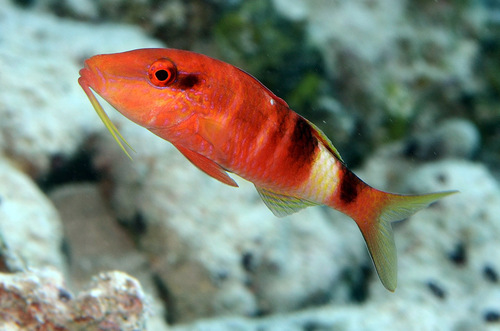


Manybar Goatfish
parupeneus multifasciatus
The Manybar Goatfish is an active and curious bottom-dwelling fish belonging to the goatfish family, Mullidae. Renowned for its busy lifestyle, this species is constantly seen vacuuming sandy stretches of Indo-Pacific coral reefs using a pair of highly flexible, whisker-like chin barbels. These barbels are packed with sensory organs that help the fish detect buried prey, making them highly efficient predators of the seafloor. Their industrious digging often attracts opportunistic 'shadow' fish, like wrasses and jacks, who follow close behind to snatch up any escaping organisms. Energetic and ecologically vital, they act as natural tillers of the marine substrate.
Hábitat: Found in shallow, warm waters of the Indo-Pacific, typically cruising over sandy patches, rubble areas, and seagrass beds near coral reefs.
This medium-sized fish typically reaches 20 to 30 centimeters in length and is characterized by a moderately compressed body with a sloping profile. Its coloration is highly variable and dynamic, generally ranging from pale grey or pinkish-white to deep reddish-brown. It is instantly recognizable by several prominent dark vertical bars or patches along its flanks, most notably a broad dark band beneath each dorsal fin and a distinct dark spot on the caudal peduncle. The defining physical feature is the pair of long, pale yellow or white chin barbels that tuck neatly under the jaw when the fish is swimming rapidly.
Categoría
PecesRareza
Common
Peligro
1/5 · Muy bajo
Snaps
¡Sé la primera persona en hacer un snap!
Other fish species, like wrasses, actively use the Manybar Goatfish as a personal hunting guide, swimming right beside its head to grab any fleeing prey.
Their sensory barbels are so sensitive that they can taste food particles buried several centimeters deep in the sand before they even dig them up.
When they sleep or hide in reef crevices at night, they often switch off their dark zebra-like bars and turn a solid, blotchy dark red color to stay hidden.
Equipped with two highly sensitive chin barbels loaded with taste buds, allowing the fish to locate and assess prey hidden beneath the sand.
Capable of rapidly shifting its color patterns from bright, contrasting bars to a mottled red or pale grey to blend in with reef structures or open sand.
Utilizes a specialized snout and powerful barbel movements to dig deep into loose sand and shift debris to uncover buried organisms.
Mainly feeds on small benthic invertebrates buried in sand, gravel, or reef crevices.
Diferencias por edad: Juveniles tend to feed on microscopic copepods and small planktonic crustaceans, while adults transition to larger, hard-shelled benthic invertebrates.
Caranx melampygus
The Bluefin Trevally frequently shadows the Manybar Goatfish to capture small prey flushed out of the sand during foraging.
Triaenodon obesus
This predator hunts Manybar Goatfish along shallow reef ledges, particularly when the goatfish are resting at night.
Labroides dimidiatus
The Bluestreak Cleaner Wrasse sets up stations where the Manybar Goatfish regularly visits to have ectoparasites removed from its skin and gills.
Aún no hay insignias de rasgos asignadas a este objeto.
Todavía no hay alias listados.
Las colecciones para este objeto aparecerán aquí a medida que se añadan más temas.
Peligro
1/5 · Muy bajo
Todavía no hay notas especiales de seguridad.
La forma más fácil de identificar a Manybar Goatfish es usar la aplicación de identificación de naturaleza Snappit.
15-35 cm
0.1-0.8 kg
3-6 años
15 km/h
Mainly feeds on small benthic invertebrates buried in sand, gravel, or reef crevices.
Found in shallow, warm waters of the Indo-Pacific, typically cruising over sandy patches, rubble areas, and seagrass beds near coral reefs.
Foraging
Acércate para separar los grupos y explorar dónde se ha fotografiado este objeto.
Los snaps recientes aparecerán aquí a medida que se añadan nuevas observaciones.