

Marbled Wild-Ginger
asarum marmoratum
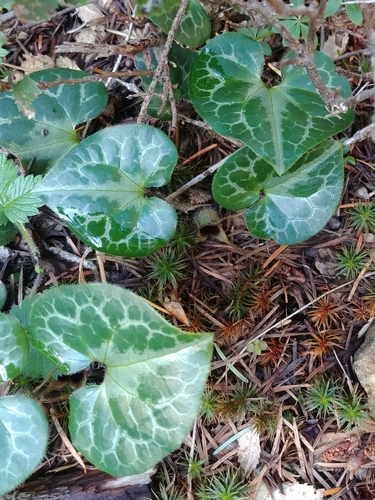
The Marbled Wild-Ginger is a charming, low-growing evergreen perennial that carpets the forest floors of the Pacific Northwest. Known for its gorgeous, thick, heart-shaped leaves adorned with intricate silvery-white veins, this plant brings a touch of delicate artistry to the shaded understory. Though its leaves are a visual highlight, its flowers are a hidden wonder, growing close to the soil surface and tucked away under the foliage. These dark, urn-shaped blossoms rely on ground-dwelling insects rather than wind or bees for pollination.
Hábitat: Typically found on shady forest floors, montane slopes, and ravines within moist coniferous forests.
Marbled Wild-Ginger features distinctive heart-shaped or spade-shaped evergreen leaves that reach about 10 to 25 centimeters in height. The deep green surface of each leaf is strikingly marbled with pale green or silvery-white markings tracing the veins. Underneath the dense leaf canopy, close to the root base, grow solitary, brownish-purple, fleshy, jug-shaped flowers. The plant spreads via underground rhizomes, forming dense, beautiful mats across the forest floor.
Categoría
PlantasRareza
Common
Peligro
1/5 · Muy bajo
Snaps
¡Sé la primera persona en hacer un snap!
Because the flowers are hidden under the leaves and leaf litter, many casual observers never realize this plant is in bloom.
The generic name Asarum comes from ancient Greek and refers to an plant used in classical medicine, though its exact meaning is obscure.
While it smells and tastes similar to culinary ginger, it is in a completely different plant family and is toxic to ingest in large quantities.
It produces seeds with nutrient-rich appendages called elaiosomes, which entice ants to carry the seeds to their nests, spreading the plant's range.
The ground-level, fleshy flowers emit a musty scent mimicking forest fungi to attract fungus gnats and beetles for pollination.
Its tissues contain aristolochic acid, a toxic compound that deters browsing mammals and insects from consuming its leaves.
As a photoautotrophic plant, it generates its own sugars using sunlight, water, and carbon dioxide through the process of photosynthesis.
Formica neorufibarbis
Ants carry the seeds back to their nests to feed on the lipid-rich elaiosomes, discarding the viable seed in a safe underground location.
Mycetophila fungorum
Gnats are lured into the jug-shaped flowers by mimicking the scent of fungi, transferring pollen in the process.
Ariolimax columbianus
Slugs occasionally feed on the low-lying, damp foliage and flower structures of wild ginger.
Aún no hay insignias de rasgos asignadas a este objeto.
Todavía no hay alias listados.
Las colecciones para este objeto aparecerán aquí a medida que se añadan más temas.
Peligro
1/5 · Muy bajo
Todavía no hay notas especiales de seguridad.
La forma más fácil de identificar a Marbled Wild-Ginger es usar la aplicación de identificación de naturaleza Snappit.
10-25 cm
5-15 años
As a photoautotrophic plant, it generates its own sugars using sunlight, water, and carbon dioxide through the process of photosynthesis.
Typically found on shady forest floors, montane slopes, and ravines within moist coniferous forests.
Acércate para separar los grupos y explorar dónde se ha fotografiado este objeto.
Los snaps recientes aparecerán aquí a medida que se añadan nuevas observaciones.