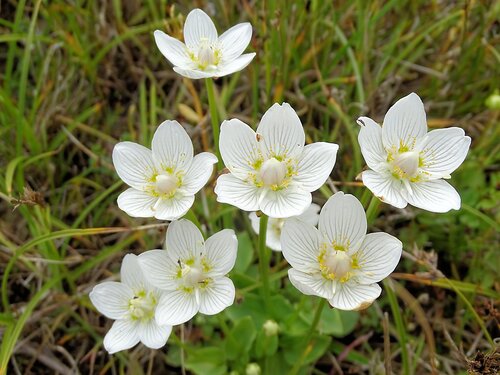


Marsh Grass-Of-Parnassus
parnassia palustris
The Marsh Grass-Of-Parnassus (Parnassia palustris) is an elegant perennial herb known for its striking white flowers that stand out in damp, marshy environments. Despite its common name, it is not a true grass, but a member of the Celastraceae family. It is a circumboreal species, widely distributed across the northern temperate regions, enchanting naturalists with its delicate appearance and intricate floral structure. This plant is a true survivor, thriving in nutrient-poor, waterlogged soils where many other species struggle, thanks to its specific adaptations. Its presence often indicates a healthy wetland ecosystem.
Hábitat: Found in fens, bogs, wet meadows, damp heathlands, stream banks, and marshes, typically thriving in waterlogged, calcareous to neutral soils.
This plant typically features a basal rosette of heart-shaped to oval, glossy green leaves. From this rosette emerges a single, slender, leafless stem (scape), usually between 5 to 30 centimeters tall, topped by a solitary, five-petaled white flower. Each petal often displays delicate greenish veins. The most distinctive feature are the five fertile stamens, which alternate with five prominent, branched staminodes (sterile stamens) that mimic droplets of nectar, serving as false nectaries to attract pollinators.
Categoría
PlantasRareza
Common
Peligro
1/5 · Muy bajo
Snaps
¡Sé la primera persona en hacer un snap!
Despite its common name, 'Grass-of-Parnassus' is not a grass but a flowering plant, named for its perceived beauty akin to the sacred Mount Parnassus in Greek mythology.
Its 'false nectaries' are a clever evolutionary trick: they look like nectar droplets but provide no actual food reward, yet still successfully attract insect pollinators.
The plant exhibits a unique 'stamen dance' where the five fertile stamens mature and curl outwards sequentially, one by one, over several days, to prevent self-pollination before the pistil becomes receptive.
The flowers exhibit protandry, meaning the male reproductive parts (stamens) mature before the female parts (pistil). The anthers release pollen one by one over several days, preventing self-pollination and promoting cross-pollination by insects.
The prominent, branched staminodes have glandular tips that glisten, mimicking drops of nectar. This visual deception attracts pollinators, such as flies and small bees, to visit the flower without offering a true reward, ensuring pollen transfer.
Marsh Grass-Of-Parnassus is highly adapted to waterlogged and nutrient-poor conditions. It possesses a robust root system and can tolerate fluctuating water levels and low oxygen levels often found in its boggy habitats.
As an autotrophic plant, Marsh Grass-Of-Parnassus produces its own food through photosynthesis, converting light energy into chemical energy. It absorbs carbon dioxide from the air and water and essential minerals from the soil.
Syrphidae spp.
Pollinators are attracted to the flower's appearance, facilitating reproduction.
Glomeromycota spp.
Specific types of fungi form beneficial relationships with plant roots, aiding nutrient uptake.
Cervus elaphus
Grazing by various herbivores can impact plant populations.
Aún no hay insignias de rasgos asignadas a este objeto.
Todavía no hay alias listados.
Las colecciones para este objeto aparecerán aquí a medida que se añadan más temas.
Peligro
1/5 · Muy bajo
Todavía no hay notas especiales de seguridad.
La forma más fácil de identificar a Marsh Grass-Of-Parnassus es usar la aplicación de identificación de naturaleza Snappit.
5-30 cm
0.005-0.05 kg
2-5 años
As an autotrophic plant, Marsh Grass-Of-Parnassus produces its own food through photosynthesis, converting light energy into chemical energy. It absorbs carbon dioxide from the air and water and essential minerals from the soil.
Found in fens, bogs, wet meadows, damp heathlands, stream banks, and marshes, typically thriving in waterlogged, calcareous to neutral soils.
Acércate para separar los grupos y explorar dónde se ha fotografiado este objeto.
Los snaps recientes aparecerán aquí a medida que se añadan nuevas observaciones.