

Maryland Senna
senna marilandica
Maryland Senna (Senna marilandica) is a charming native perennial in the pea family, Fabaceae, bringing a splash of cheerful yellow to meadows, open woodlands, and roadsides across the eastern and central United States. This robust plant is valued not only for its attractive late-summer blooms but also for its significant ecological contributions. It serves as a vital larval host plant for several butterfly species, including the Cloudless Sulphur, and its flowers provide abundant nectar for a variety of native bees. Beyond its beauty, Maryland Senna plays a crucial role in soil health through nitrogen fixation, making it an excellent candidate for ecological restoration projects and native plant gardens. Its distinctive seed pods, appearing after flowering, add further interest through the fall and winter.
Hábitat: This species thrives in open, sunny to partially shaded environments, commonly found in moist to dry-mesic soils of open woodlands, woodland edges, meadows, fields, roadsides, and disturbed areas.
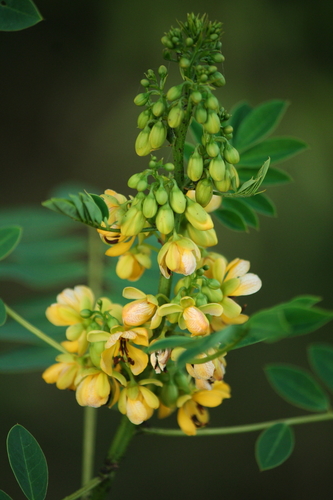
Maryland Senna is characterized by its bright, sunny yellow flowers, typically blooming from mid-summer into early fall. The flowers are arranged in short, axillary clusters and have five distinct petals, often with a slightly irregular shape. Its foliage consists of pinnately compound leaves, each composed of 6 to 10 pairs of oblong to lance-shaped leaflets that are smooth and dark green. The plant grows as an upright, herbaceous perennial, reaching heights of 90 to 180 centimeters (3 to 6 feet). After the flowers fade, long, flat, dark brown to black seed pods develop, adding to its visual appeal and aiding in identification.
Categoría
PlantasRareza
Common
Peligro
1/5 · Muy bajo
Snaps
¡Sé la primera persona en hacer un snap!
Its seed pods, resembling flattened green beans, turn dark brown to black as they mature and persist on the plant into winter, providing visual interest.
Maryland Senna is a popular choice for native plant gardens and pollinator gardens due to its low maintenance, drought tolerance, and ecological benefits.
The genus name 'Senna' comes from the Arabic word 'sana', referring to a plant whose leaves and pods have purgative properties, though this specific species is not widely used medicinally.
Unlike many plants, Maryland Senna requires 'buzz pollination' (sonication) where bees vibrate their flight muscles to release pollen from specialized anthers.
Maryland Senna, like many legumes, forms a symbiotic relationship with soil bacteria (Rhizobia) in its root nodules. These bacteria convert atmospheric nitrogen into a form usable by the plant, enriching the soil for itself and surrounding vegetation.
Its bright yellow flowers are a significant source of nectar and pollen, attracting a wide array of native pollinators, particularly long-tongued bees such as bumblebees and carpenter bees. It also features 'poricidal anthers' which require buzz pollination.
The foliage of Maryland Senna serves as a critical food source for the caterpillars of several butterfly species, notably the Cloudless Sulphur (Phoebis sennae) and the Sleepy Orange (Eurema nicippe), supporting their life cycles.
As a photosynthetic organism, Maryland Senna produces its own food by converting light energy into chemical energy. It absorbs water and essential mineral nutrients from the soil, and carbon dioxide from the air to fuel its growth and metabolic processes.
Phoebis sennae
The caterpillars feed on the leaves of Maryland Senna.
Bombus spp.
They collect nectar and pollen from the flowers, facilitating cross-pollination.
Odocoileus virginianus
Grazing animals may browse on the foliage, especially younger plants.
Rhizobium spp.
These bacteria live in root nodules and convert atmospheric nitrogen into usable forms for the plant.
Aún no hay insignias de rasgos asignadas a este objeto.
Todavía no hay alias listados.
Las colecciones para este objeto aparecerán aquí a medida que se añadan más temas.
Peligro
1/5 · Muy bajo
Todavía no hay notas especiales de seguridad.
La forma más fácil de identificar a Maryland Senna es usar la aplicación de identificación de naturaleza Snappit.
90-180 cm
0.5-2.5 kg
3-10 años
As a photosynthetic organism, Maryland Senna produces its own food by converting light energy into chemical energy. It absorbs water and essential mineral nutrients from the soil, and carbon dioxide from the air to fuel its growth and metabolic processes.
This species thrives in open, sunny to partially shaded environments, commonly found in moist to dry-mesic soils of open woodlands, woodland edges, meadows, fields, roadsides, and disturbed areas.
Acércate para separar los grupos y explorar dónde se ha fotografiado este objeto.
Los snaps recientes aparecerán aquí a medida que se añadan nuevas observaciones.