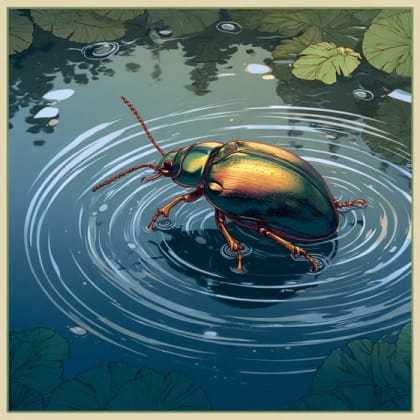
Meadow Flies
Chrysotoxum
Meadow flies are small, colorful insects that love to buzz around flowers. They are often seen in sunny meadows, where they help pollinate plants while searching for nectar.
Hábitat: Meadows
The Meadow Flies has a slender body, often featuring bright yellow and black stripes across its abdomen, making it resemble a wasp or bee. It possesses two clear wings and large, prominent compound eyes that cover much of its head. Their short, stubby antennae distinguish them from the longer antennae of bees.
Categoría
InsectosRareza
Common
Peligro
1/5 · Muy bajo
Snaps
¡Sé la primera persona en hacer un snap!
Instead of chewing, adult Meadow Flies use a spongy tongue to slurp up sweet nectar.
Some Meadow Flies larvae are secret agents, living hidden inside ant nests!
Their wings beat so incredibly fast, over 200 times every single second!
Wow! Meadow Flies can fly backwards and sideways, amazing aerial tricks!
Meadow Flies can stay perfectly still in mid-air because of their powerful wing muscles, which helps them search for flowers or avoid predators.
Meadow Flies has bright yellow and black patterns that make them look like wasps, which helps them scare away hungry birds and other attackers.
Meadow Flies larvae can gobble up many tiny aphids because of their strong mouthparts, which helps farmers protect their crops naturally.
Adults sip sweet nectar and pollen, while their hungry young often munch on garden pests!
Diferencias por edad: Larvae are often carnivorous, feasting on aphids, while adults primarily feed on nectar and pollen.
_Clock_-_Tennessee%2C_USA_-_May_31%2C_2014.jpg&width=800)
Taraxacum officinale
Adults visit their flowers for nectar and pollen.
Aphis gossypii
Their larvae prey on these tiny garden pests.
%2C_Parc_de_Woluw%C3%A9%2C_Brussels_(13042792905).jpg&width=800)
Parus major
A common bird that will feed on adult flies.
Rubus idaeus
Help these plants produce their delicious fruit.
Los animales sociales viven en grupos organizados, cooperando para obtener beneficios de supervivencia como la búsqueda de alimento, la defensa y la cría de descendencia.
Colorido describe a organismos u objetos que exhiben una amplia variedad de colores brillantes y distintivos.
Este rasgo caracteriza a los organismos cuya dieta consiste total o principalmente en material vegetal.
Describe plantas que son particularmente atractivas y beneficiosas para una amplia variedad de organismos polinizadores.

Los hábitats de pastizales son biomas terrestres dominados por pastos y plantas herbáceas, que sustentan a una variedad de animales de pastoreo.

Los animales diurnos están activos principalmente durante el día y suelen descansar o dormir por la noche.

Describe organismos que transfieren polen, permitiendo la fertilización y reproducción de las plantas.
Todavía no hay alias listados.
Peligro
1/5 · Muy bajo
Meadow flies are harmless, but it's best to watch them from a distance.
15-30 mm
8-18 mm
15-40 días
10 km/h
Adults sip sweet nectar and pollen, while their hungry young often munch on garden pests!
Meadows
Foraging
6
Acércate para separar los grupos y explorar dónde se ha fotografiado este objeto.
Los snaps recientes aparecerán aquí a medida que se añadan nuevas observaciones.