





Megalodacne heros
Megalodacne heros
El Megalodacne heros es un tipo especial de escarabajo al que le encanta masticar hojas. ¡Tiene un caparazón brillante y colorido que lo hace parecer una pequeña joya en el jardín!
Hábitat: Bosques
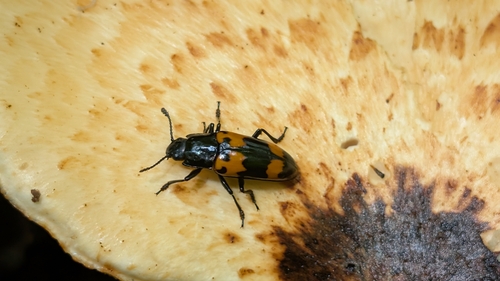
El Megalodacne heros es un escarabajo de tamaño mediano, con un cuerpo negro brillante, alargado y ovalado, adornado con dos prominentes y vibrantes bandas de color rojo anaranjado en sus élitros. Su llamativa coloración proporciona un audaz contraste, lo que lo hace fácilmente distinguible entre otros insectos del bosque.
Categoría
InsectosRareza
Common
Peligro
1/5 · Muy bajo
Snaps
4
Sus larvas también mastican hongos, creciendo dentro de ellos antes de pupar.
¡Megalodacne heros significa 'héroe comedor de hongos grandes', un nombre muy apropiado!
¡Sus colores brillantes actúan como una señal de advertencia para pájaros y lagartos hambrientos!
¡Este escarabajo ayuda a los bosques comiendo hongos que descomponen los árboles!
A este escarabajo le encanta comer varios tipos de hongos de repisa que se encuentran en madera muerta o en descomposición.
Diferencias por edad: Larvas y adultos se alimentan de hongos.
Trametes versicolor
Adultos y larvas consumen sus cuerpos fructíferos.

Poecile carolinensis
Pequeños pájaros podrían depredar escarabajos adultos.

Peromyscus leucopus
Los roedores que buscan comida en los troncos pueden comer los escarabajos.
Los animales solitarios viven solos durante la mayor parte de su vida y solo interactúan con otros para aparearse o cuidar de sus crías.
Colorido describe a organismos u objetos que exhiben una amplia variedad de colores brillantes y distintivos.
Este rasgo caracteriza a los organismos cuya dieta consiste total o principalmente en material vegetal.
Los hábitats boscosos son entornos terrestres dominados por una densa cubierta arbórea, que sustentan una gran diversidad de vida animal y vegetal.

Describe a los organismos que descomponen la materia orgánica muerta, reciclando los nutrientes de vuelta al ecosistema.

Los animales diurnos están activos principalmente durante el día y suelen descansar o dormir por la noche.

Describe organismos que transfieren polen, permitiendo la fertilización y reproducción de las plantas.
Todavía no hay alias listados.
Peligro
1/5 · Muy bajo
Sé suave y mira por dónde pisas para evitar aplastar pequeños escarabajos como este.
La forma más fácil de identificar a Megalodacne heros es usar la aplicación de identificación de naturaleza Snappit.
24-36 mm
12-18 mm
45-120 días
7 km/h
A este escarabajo le encanta comer varios tipos de hongos de repisa que se encuentran en madera muerta o en descomposición.
Bosques
Forrajeo
Acércate para separar los grupos y explorar dónde se ha fotografiado este objeto.
28 abr 2026
Selmier State ForestFuente abierta (iNaturalist) ↗
Créditos de la foto
(c) Peyton Phelps, some rights reserved (CC BY)
Licencia: CC BY 4.0 ↗
La imagen puede mostrarse recortada dentro del marco de la carta.

Connecticut, US
Puedes ver Viburno Arrancapies, Zapatito De Dama Rosado y Trillium Rojo.
Ver guía →

New York, US
Puedes ver Raíz De Cáncer Americana y Gaviota De Delaware.
Ver guía →
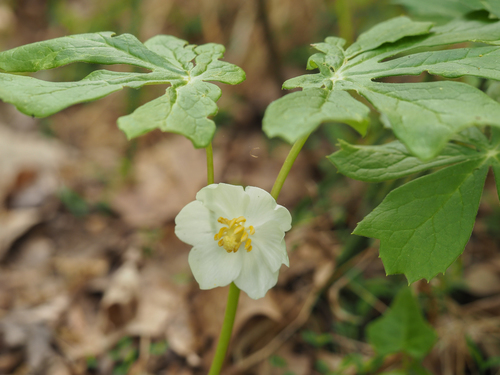
Indiana, US
Puedes ver Manzana De Mayo y Campanillas De Virginia.
Ver guía →

Pennsylvania, US
Puedes ver Hongo De Laca De Tsuga, Laurel De Montaña y Helecho Canela.
Ver guía →

Pennsylvania, US
Puedes ver Baya De Perdiz, Tsuga Del Canadá y Haya Americana.
Ver guía →
Llévate el descubrimiento
Haz una foto con Snappit, identifica la especie y guarda el hallazgo en tu colección.







.jpg&width=800)


