

Microcystis Smithii
microcystis smithii
Microcystis smithii es una especie fascinante de cianobacterias coloniales, comúnmente conocidas como algas verdeazuladas, aunque biológicamente es una bacteria. Prosperando en ambientes de agua dulce cálidos y ricos en nutrientes, este organismo microscópico juega un papel vital en los ecosistemas acuáticos. Por un lado, es un productor fotosintético altamente eficiente, que contribuye al ciclo global del carbono y libera oxígeno al agua. Por otro lado, bajo condiciones óptimas de alta temperatura y escorrentía agrícola, puede multiplicarse rápidamente para formar floraciones densas y conspicuas que dominan la superficie del agua. Estas colonias están unidas por una vaina mucilaginosa protectora, lo que les permite soportar diversas tensiones ambientales. Como representante clave del fitoplancton de agua dulce, Microcystis smithii es de gran interés para limnólogos y ecólogos que estudian la calidad del agua y los impactos de la eutrofización en todo el mundo.
Hábitat: Se encuentra en ambientes de agua dulce eutróficos, particularmente lagos cálidos, embalses, estanques y ríos de flujo lento ricos en nitrógeno y fósforo.
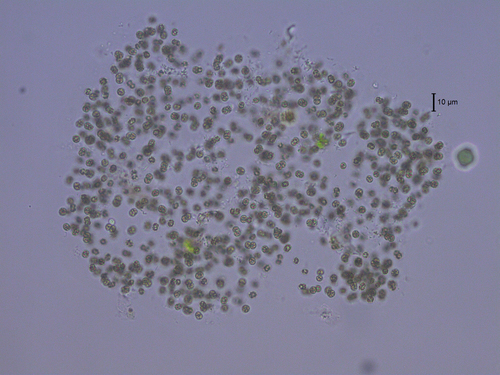
A nivel microscópico, Microcystis smithii consiste en células pequeñas, esféricas o hemisféricas que miden aproximadamente de 3 a 6 micrómetros de diámetro. Estas células se agrupan en colonias más grandes y altamente variables que pueden aparecer esféricas, oblongas o lobuladas irregularmente, a menudo rodeadas por un mucílago claro y estructurado. A simple vista, una alta concentración de estas colonias aparece como una decoloración vibrante de color verde guisante a verde azulado en el agua, asemejándose a pintura derramada o una espuma espesa y pulverulenta flotando en la superficie.
Categoría
AnimalRareza
Común
Peligro
1/5 · Muy bajo
Snaps
¡Sé la primera persona en hacer un snap!
Los ancestros de cianobacterias como Microcystis fueron responsables del Gran Evento de Oxidación hace 2.400 millones de años, que creó la atmósfera rica en oxígeno de la Tierra.
A pesar de ser llamadas 'algas verdeazuladas', Microcystis smithii es en realidad una bacteria fotosintética, lo que significa que carece de un núcleo celular.
Bajo condiciones cálidas y contaminadas por nutrientes, pueden formar floraciones masivas visibles desde el espacio, tiñendo cuerpos de agua enteros de color verde brillante.
Utiliza vesículas de gas internas para ajustar su densidad, permitiendo que las células suban a la superficie del agua para la fotosíntesis durante el día y se hundan para absorber nutrientes por la noche.
Produce una vaina gruesa y gelatinosa que rodea la colonia, lo que protege a las células de la desecación y disuade a los pastoreadores microscópicos.
Utiliza la luz solar y la clorofila para dividir las moléculas de agua, generando oxígeno como subproducto, lo que históricamente ayudó a dar forma a la atmósfera de la Tierra.
Como cianobacteria fotosintética, genera su propia energía a partir de la luz solar, el dióxido de carbono y los nutrientes inorgánicos disueltos en el agua.
Daphnia magna
Consume células de Microcystis, aunque el pastoreo a menudo está limitado por el tamaño de la colonia y las posibles toxinas.
Hypophthalmichthys molitrix
Filtra grandes cantidades de cianobacterias, ayudando a controlar las floraciones de agua en ecosistemas de agua dulce gestionados.
Microcystis virus Ma-LMM01
Infecta y lisa las células de Microcystis, actuando como un agente de control biológico natural para colapsar las floraciones.
Aún no hay insignias de rasgos asignadas a este objeto.
Todavía no hay alias listados.
Las colecciones para este objeto aparecerán aquí a medida que se añadan más temas.
Peligro
1/5 · Muy bajo
Todavía no hay notas especiales de seguridad.
La forma más fácil de identificar a Microcystis Smithii es usar la aplicación de identificación de naturaleza Snappit.
0 cm
Como cianobacteria fotosintética, genera su propia energía a partir de la luz solar, el dióxido de carbono y los nutrientes inorgánicos disueltos en el agua.
Se encuentra en ambientes de agua dulce eutróficos, particularmente lagos cálidos, embalses, estanques y ríos de flujo lento ricos en nitrógeno y fósforo.
Acércate para separar los grupos y explorar dónde se ha fotografiado este objeto.
Los snaps recientes aparecerán aquí a medida que se añadan nuevas observaciones.
Llévate el descubrimiento
Haz una foto con Snappit, identifica la especie y guarda el hallazgo en tu colección.