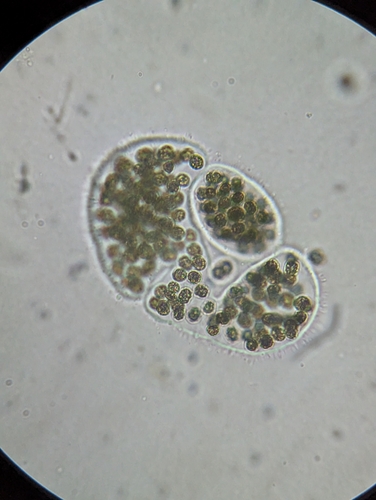


Microcystis Wesenbergii
microcystis wesenbergii
Microcystis wesenbergii es una cianobacteria colonial unicelular fascinante, que se encuentra comúnmente en ambientes de agua dulce a nivel mundial. Conocida por formar colonias flotantes, esta bacteria fotosintética desempeña un papel complejo en los ecosistemas acuáticos. Aunque contribuye a la productividad primaria al cosechar la luz solar, también es famosa por su participación en floraciones algales nocivas en condiciones ricas en nutrientes. A diferencia de algunos de sus notorios parientes, Microcystis wesenbergii a menudo se considera menos tóxica o no tóxica, aunque frecuentemente coexiste con especies productoras de toxinas. Encapsulados en una vaina gelatinosa distintiva y bien definida, estos organismos microscópicos se agrupan, utilizando vesículas de gas que regulan la flotabilidad para moverse hacia arriba y hacia abajo en la columna de agua y optimizar la absorción de luz.
Hábitat: Se encuentra flotando en lagos de agua dulce eutróficos, embalses, estanques y ríos de movimiento lento en todo el mundo.
Microcystis wesenbergii forma colonias esféricas, lobuladas o de forma irregular que varían de color verde pálido a verde azulado. Las células individuales son esféricas, miden entre 4 y 7 micrómetros de diámetro, y están empaquetadas dentro de una envoltura mucilaginosa altamente visible, refringente y estructurada. Esta vaina gelatinosa externa tiene un límite nítido y distintivo que la distingue claramente de otras especies de Microcystis bajo un microscopio óptico. Macroscópicamente, las acumulaciones densas parecen sopa de guisantes verde o pintura derramada en la superficie del agua.
Categoría
AnimalRareza
Común
Peligro
1/5 · Muy bajo
Snaps
¡Sé la primera persona en hacer un snap!
Utilizan vesículas de gas especializadas para ascender a la superficie durante el día para fotosintetizar, y se hunden por la noche para absorber nutrientes de aguas más frías y profundas.
Bajo el microscopio, la característica definitoria de Microcystis wesenbergii es su borde gelatinoso exterior notablemente nítido y similar al vidrio, que parece un halo claro.
Aunque algunas especies de Microcystis producen toxinas microcistinas mortales, M. wesenbergii generalmente se considera no tóxica, aunque a menudo vive junto a parientes altamente tóxicos.
Como cianobacteria fotosintética, genera su propia energía a partir de la luz solar, el agua y el dióxido de carbono, mientras absorbe nutrientes disueltos como fósforo y nitrógeno directamente del agua circundante.
Aún no hay insignias de rasgos asignadas a este objeto.
Todavía no hay alias listados.
Las colecciones para este objeto aparecerán aquí a medida que se añadan más temas.
Peligro
1/5 · Muy bajo
Todavía no hay notas especiales de seguridad.
La forma más fácil de identificar a Microcystis Wesenbergii es usar la aplicación de identificación de naturaleza Snappit.
Como cianobacteria fotosintética, genera su propia energía a partir de la luz solar, el agua y el dióxido de carbono, mientras absorbe nutrientes disueltos como fósforo y nitrógeno directamente del agua circundante.
Se encuentra flotando en lagos de agua dulce eutróficos, embalses, estanques y ríos de movimiento lento en todo el mundo.
Acércate para separar los grupos y explorar dónde se ha fotografiado este objeto.
Los snaps recientes aparecerán aquí a medida que se añadan nuevas observaciones.
Llévate el descubrimiento
Haz una foto con Snappit, identifica la especie y guarda el hallazgo en tu colección.