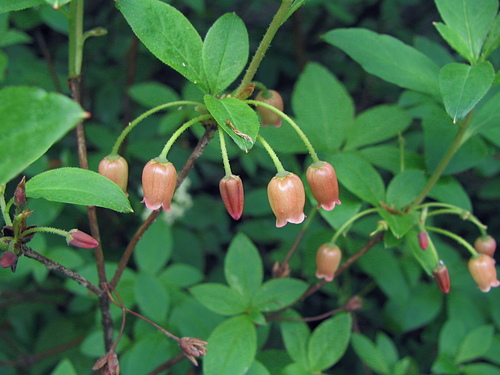


Mock Azalea
rhododendron menziesii
Mock Azalea (Rhododendron menziesii), also known as fool's huckleberry, is a hardy deciduous shrub native to the moist, montane forests of western North America. Growing in shady, damp woodlands, this resilient plant often tricks hikers into thinking they have found wild huckleberries or true azaleas. While its delicate, bell-shaped coppery-pink blossoms are highly attractive to forest pollinators, its foliage has a distinctive skunky or musky aroma when crushed. It plays a subtle but vital role in its native ecosystem, offering cover to small forest creatures and helping to stabilize steep mountain soils.
Hábitat: Found in moist, shady coniferous forests, subalpine slopes, and stream banks of western North America.
This deciduous shrub typically stands 1 to 3 meters tall, featuring slender, spreading branches that grow in distinctive pseudo-whorls. Its oval, thin-textured leaves are a soft, dull green with finely glandular-serrated edges and a rusty-hairy texture on the upper surface. In late spring to mid-summer, Mock Azalea produces clusters of small, nodding, urn-shaped flowers ranging from copper to salmon-orange or pinkish-yellow. Unlike the edible huckleberries it mimics, its fruit is a dry, hard, four-valved woody capsule that splits open when mature.
Categoría
PlantasRareza
Common
Peligro
1/5 · Muy bajo
Snaps
¡Sé la primera persona en hacer un snap!
Despite being in the Rhododendron genus, it was historically classified in its own genus, Menziesia, named after the Scottish naturalist Archibald Menzies.
Its common name, 'fool's huckleberry,' comes from its strong resemblance to huckleberry bushes, often disappointing foragers who search its branches only to find dry wood capsules instead of sweet, juicy berries.
The leaves emit a distinct skunk-like odor when crushed, which is a great diagnostic tool for distinguishing it from other forest shrubs.
Emits a musky, skunk-like odor from glandular hairs on its leaves when bruised, which deters browsing herbivores.
Utilizes a specialized ericoid mycorrhizal association in its roots to extract scarce nutrients from highly acidic forest soils.
Features sticky, glandular hairs on its twigs and leaves that help retain moisture and deter crawling insect pests.
As a photoautotroph, this plant synthesizes its own energy from sunlight, water, and carbon dioxide through the process of photosynthesis.
Bombus sylvicola
Pollinated by bumblebees seeking nectar in late spring and summer.
Exobasidium vaccinii
Host to a parasitic gall-forming fungus that deforms leaves and stems.
Cervus canadensis
Browsed occasionally in winter when other food sources are scarce, though of low nutritional preference.
Aún no hay insignias de rasgos asignadas a este objeto.
Todavía no hay alias listados.
Las colecciones para este objeto aparecerán aquí a medida que se añadan más temas.
Peligro
1/5 · Muy bajo
Todavía no hay notas especiales de seguridad.
La forma más fácil de identificar a Mock Azalea es usar la aplicación de identificación de naturaleza Snappit.
50-300 cm
20-60 años
As a photoautotroph, this plant synthesizes its own energy from sunlight, water, and carbon dioxide through the process of photosynthesis.
Found in moist, shady coniferous forests, subalpine slopes, and stream banks of western North America.
Acércate para separar los grupos y explorar dónde se ha fotografiado este objeto.
Los snaps recientes aparecerán aquí a medida que se añadan nuevas observaciones.
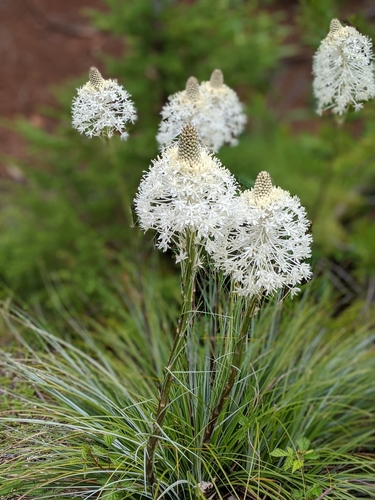
British Columbia, CA
Puedes ver Hierba De Oso y Alerce Subalpino.
Ver guía →

British Columbia, CA
Puedes ver Coma Verde, Mariposa Capa De Luto y Coma Canosa.
Ver guía →