
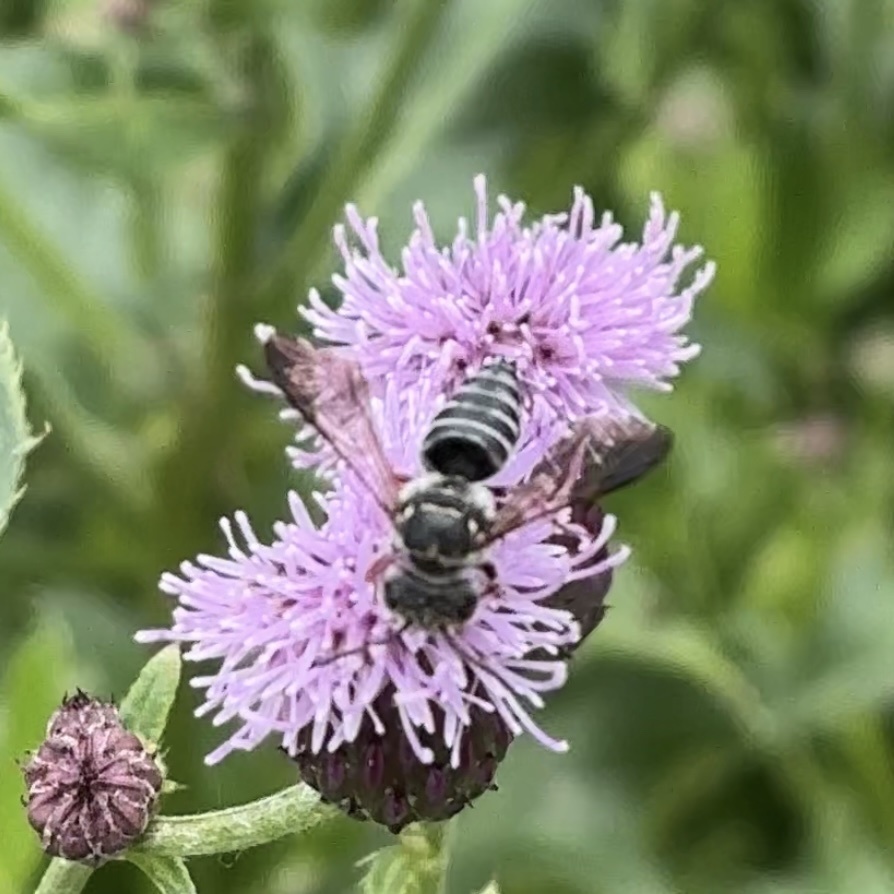





Modest Sharptail
Coelioxys modestus
The Modest Sharptail is a special kind of bee that loves to visit flowers. It helps plants grow by spreading pollen while it collects nectar. These bees are small and have a unique shape that makes them stand out!
Hábitat: Urban areas, Gardens
The Modest Sharptail is a slender, black bee with a shiny, pointed abdomen featuring narrow, pale bands of hair. Its body has sparse, light hairs, giving it a more wasp-like appearance compared to fuzzy bees.
Categoría
InsectosRareza
Common
Peligro
1/5 · Muy bajo
Snaps
¡Sé la primera persona en hacer un snap!
Female Modest Sharptails have a very pointy tail, like a tiny hardened spear!
Modest Sharptails don't build their own nests, they sneak into other bees' homes!
Their babies grow by eating the food collected by other hard-working mother bees!
These sneaky bees don't collect pollen themselves; they just steal it!
Modest Sharptail can lay its eggs in other bees' nests because its larvae will steal their food, helping them survive.
Modest Sharptail has a tough, conical abdomen that helps them break into host nests or defend against rivals.
Modest Sharptail can lay eggs that mimic the host's eggs, helping them go undetected in foreign nests.
These sneaky bees steal pollen and nectar gathered by other bees to feed their young.
Diferencias por edad: Larvae consume host bee's stored food and sometimes host eggs/larvae, while adults feed on nectar from flowers.

Megachile campanulae
Lays eggs in their nests and steals their food stores.
Megachile texana
Their young grow by consuming this bee's stored pollen.

Trifolium repens
Adults drink nectar from its flowers for energy.
Los animales sociales viven en grupos organizados, cooperando para obtener beneficios de supervivencia como la búsqueda de alimento, la defensa y la cría de descendencia.
Colorido describe a organismos u objetos que exhiben una amplia variedad de colores brillantes y distintivos.
Este rasgo caracteriza a los organismos cuya dieta consiste total o principalmente en material vegetal.
Describe plantas que son particularmente atractivas y beneficiosas para una amplia variedad de organismos polinizadores.

Los animales diurnos están activos principalmente durante el día y suelen descansar o dormir por la noche.

Relativo a especies que son significativamente más pequeñas que lo típico o promedio de su tipo.

Esta característica de hábitat indica especies que pueden coexistir con los humanos en entornos urbanos y suburbanos, utilizando estructuras artificiales y espacios verdes.

Describe organismos que transfieren polen, permitiendo la fertilización y reproducción de las plantas.
Todavía no hay alias listados.
Peligro
1/5 · Muy bajo
Stay calm and still if you see a bee; they usually won't bother you.
15-25 mm
7-12 mm
30-60 días
12 km/h
These sneaky bees steal pollen and nectar gathered by other bees to feed their young.
Urban areas, Gardens
6
Acércate para separar los grupos y explorar dónde se ha fotografiado este objeto.
Los snaps recientes aparecerán aquí a medida que se añadan nuevas observaciones.













.jpg&width=800)


