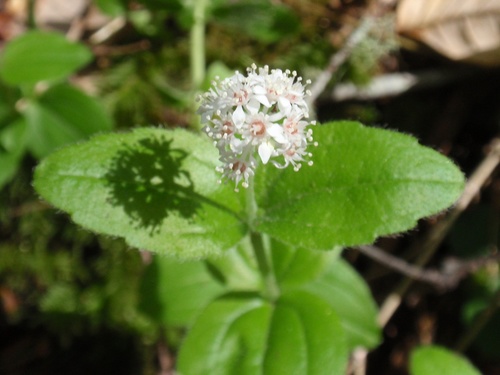


Modesty
whipplea modesta
Modesty, scientifically known as Whipplea modesta, is a charming, low-growing deciduous subshrub native to the Pacific Northwest. Despite its humble appearance, this plant plays an important ecological role as a ground cover in forest understories. It forms dense, spreading mats, creating a lush carpet on the forest floor that helps with soil stabilization and provides habitat for small invertebrates. Its delicate white flowers, though small, add a touch of subtle beauty to the woodland landscape, particularly in late spring and early summer.
Hábitat: Found in moist, shady woods, especially conifer forests, streambanks, and often on disturbed sites or forest edges.
Whipplea modesta is a low-growing subshrub, typically reaching 10-30 centimeters in height but spreading much wider. Its stems are slender, woody, and tend to creep along the ground, often rooting as they go. The leaves are small, ovate, toothed along the edges, and bright green, turning reddish-bronze in autumn before dropping. In spring, it produces clusters of small, inconspicuous white flowers, each with typically three petal-like sepals, which give it a delicate, star-like appearance against the green foliage.
Categoría
PlantasRareza
Common
Peligro
1/5 · Muy bajo
Snaps
¡Sé la primera persona en hacer un snap!
Despite its small size, Modesty is an excellent groundcover plant for shaded gardens, often used in native plant landscaping to mimic forest undergrowth.
Its evergreen-like habit in milder climates, combined with its ability to root along its creeping stems, makes it highly effective at stabilizing soil and preventing erosion on woodland slopes.
The genus 'Whipplea' is named after Amiel Weeks Whipple, an American military officer and surveyor, while 'modesta' refers to its modest or unassuming appearance.
Whipplea modesta spreads vigorously through its creeping stems (rhizomes) which root at nodes, allowing it to form dense, expansive mats across the forest floor. This clonal growth enables it to quickly colonize suitable areas.
This subshrub is highly adapted to low light conditions, thriving in the dappled sunlight and deep shade of conifer forests. Its efficient photosynthetic mechanisms allow it to flourish where many other plants struggle.
Its extensive network of shallow, fibrous roots and dense mat-forming habit effectively binds soil, preventing erosion on slopes and along streambanks, contributing to the stability of woodland ecosystems.
As an autotrophic plant, Modesty produces its own food through photosynthesis, utilizing sunlight, carbon dioxide from the air, and water and minerals absorbed from the soil.
Various genera (e.g., Lasioglossum spp.)
Pollinates flowers to enable seed production.
Odocoileus hemionus columbianus
Grazes on foliage, particularly young shoots.
Various species
Forms a symbiotic relationship, enhancing nutrient uptake for the plant.
Myodes californicus
Provides ground cover and shelter.
Aún no hay insignias de rasgos asignadas a este objeto.
Todavía no hay alias listados.
Las colecciones para este objeto aparecerán aquí a medida que se añadan más temas.
Peligro
1/5 · Muy bajo
Todavía no hay notas especiales de seguridad.
La forma más fácil de identificar a Modesty es usar la aplicación de identificación de naturaleza Snappit.
10-30 cm
5-15 años
As an autotrophic plant, Modesty produces its own food through photosynthesis, utilizing sunlight, carbon dioxide from the air, and water and minerals absorbed from the soil.
Found in moist, shady woods, especially conifer forests, streambanks, and often on disturbed sites or forest edges.
Acércate para separar los grupos y explorar dónde se ha fotografiado este objeto.
Los snaps recientes aparecerán aquí a medida que se añadan nuevas observaciones.