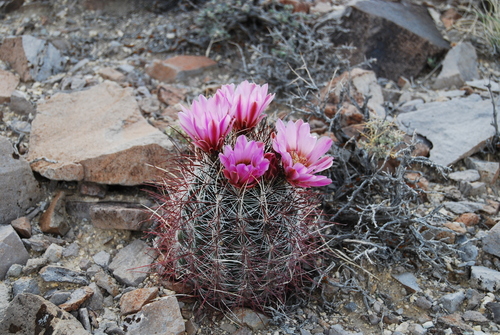


Mojave Fishhook Cactus
sclerocactus polyancistrus
The Mojave Fishhook Cactus (Sclerocactus polyancistrus) is a striking, heavily armed succulent native to the arid expanses of the Mojave and Great Basin deserts. Enduring some of the harshest environments in North America, this resilient cactus is celebrated for its dramatic armor of spines and breathtaking spring blooms. Growing as solitary, ribbed cylinders, it forms a dense lattice of white, yellow, and vibrant red spines that act as a natural sunscreen and deterrent to thirsty desert fauna. In late spring, the desert landscape is punctuated by its spectacular, funnel-shaped flowers, which boast vivid shades of magenta and purple. These beautiful blooms provide a vital nectar source for native desert pollinators. As a slow-growing specialist, the Mojave Fishhook Cactus has adapted brilliantly to rocky, dry slopes, serving as a symbol of endurance and natural beauty in the American Southwest.
Hábitat: Found on gravelly slopes, alluvial fans, and rocky hillsides within desert scrub communities, typically at elevations between 500 and 2,000 meters.
This cactus features a cylindrical stem that grows between 10 to 45 centimeters in height and 7 to 15 centimeters in diameter. It is highly distinguished by its complex arrangement of spines: numerous straight, white radial spines lie flat against the stem, while 10 to 12 longer central spines thrust outward. These central spines are a mix of bright red or dark reddish-brown, with several of the upper and lower ones sharply hooked like a fishhook. During its blooming season from April to June, it produces large, showy flowers at the top of the stem, measuring 5 to 10 centimeters across, in brilliant shades of magenta, rose-purple, or rarely yellow.
Categoría
PlantasRareza
Common
Peligro
1/5 · Muy bajo
Snaps
¡Sé la primera persona en hacer un snap!
Despite its intimidating armor of spines, it is highly prized by cactus enthusiasts for having some of the largest and most colorful flowers of any Mojave Desert species.
The seeds of the Mojave Fishhook Cactus require a cold winter period, known as stratification, followed by summer rains before they will successfully germinate in the wild.
The species name 'polyancistrus' is derived from Greek words meaning 'many fishhooks', a direct nod to its intensely hooked spines.
Utilizes Crassulacean Acid Metabolism to open its stomata and absorb carbon dioxide at night, drastically reducing water loss during scorching desert days.
Features heavily hooked central spines that deter large herbivores and can catch on passing animals to aid in deterring threats.
The thick, overlapping network of brightly colored spines reflects intense solar radiation and creates a microclimate of still air to minimize evaporation.
As a photosynthetic plant, it manufactures its own chemical energy using sunlight, water, and carbon dioxide.
Gopherus agassizii
The desert tortoise occasionally consumes the fallen flowers, moist fruits, and seeds of this cactus as a seasonal water and nutrient source.
Diadasia opuntiae
Native bees, particularly chimney bees, visit the large, nectar-rich magenta flowers to forage for pollen and nectar, facilitating pollination.
Neotoma lepida
Desert woodrats occasionally chew on the base of the cactus for moisture during severe droughts, navigating past the sharp spines.
Aún no hay insignias de rasgos asignadas a este objeto.
Todavía no hay alias listados.
Las colecciones para este objeto aparecerán aquí a medida que se añadan más temas.
Peligro
1/5 · Muy bajo
Todavía no hay notas especiales de seguridad.
La forma más fácil de identificar a Mojave Fishhook Cactus es usar la aplicación de identificación de naturaleza Snappit.
10-45 cm
0.5-4 kg
30-80 años
As a photosynthetic plant, it manufactures its own chemical energy using sunlight, water, and carbon dioxide.
Found on gravelly slopes, alluvial fans, and rocky hillsides within desert scrub communities, typically at elevations between 500 and 2,000 meters.
Acércate para separar los grupos y explorar dónde se ha fotografiado este objeto.
Los snaps recientes aparecerán aquí a medida que se añadan nuevas observaciones.




















