

Mojave Seablite
suaeda nigra
The Mojave Seablite (Suaeda nigra) is a highly resilient perennial shrub native to the arid desert regions of western North America. Flourishing in harsh, saline basins and desert washes where few other plants can survive, this tough halophyte plays an essential role in stabilizing desert soils and providing shelter for local fauna. It is celebrated for its remarkable ability to tolerate extreme alkaline conditions, absorbing salts from the soil and storing them in its fleshy leaves. Over the seasons, the shrub's foliage undergoes a subtle color transformation, offering an unexpected splash of hues in otherwise barren landscapes.
Hábitat: Typically found in highly saline or alkaline soils, salt flats, desert sinks, and playas across the southwestern United States and northern Mexico.
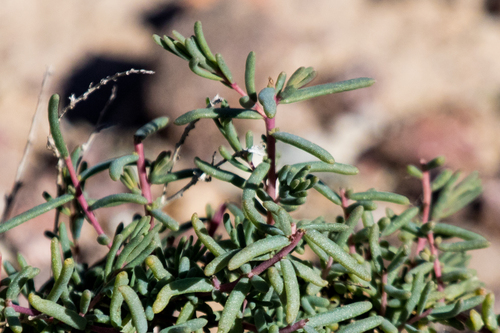
This woody-based shrub grows up to 150 centimeters tall with heavily branched, spreading stems. It features small, fleshy, cylindrical or lance-shaped succulent leaves that range in color from a dusty green to deep reddish-purple, depending on salt accumulation and water stress. Its flowers are tiny, inconspicuous, and greenish-yellow, cluster-arranged directly along the upper stems during the blooming season.
Categoría
PlantasRareza
Common
Peligro
1/5 · Muy bajo
Snaps
¡Sé la primera persona en hacer un snap!
Indigenous peoples gathered the seeds of the Mojave Seablite to grind into a nutritious meal or flour.
Its leaves change from bright green to purple or deep red as a stress response to high salt levels and dry conditions.
The ashes of burned seablite plants were historically used as a source of soda ash to manufacture soap and glass.
It absorbs and stores high levels of salt within its leaf vacuoles, allowing it to draw water from highly saline desert soils.
Stores precious moisture in thick, fleshy leaves to withstand prolonged desert droughts and intense summer heat.
Utilizes a specialized photosynthetic pathway to maximize energy production while minimizing water loss in hot, arid conditions.
As a primary producer, it generates its own energy through photosynthesis, utilizing sunlight, carbon dioxide, and underground saline water sources.
Brephidium exilis
The caterpillars of this small butterfly use the plant as their primary larval host.
Perognathus parvus
Forages on the seeds of the Mojave Seablite in desert environments.
Glomus intraradices
Forms a symbiotic relationship in the roots to assist the plant with nutrient absorption.
Aún no hay insignias de rasgos asignadas a este objeto.
Todavía no hay alias listados.
Las colecciones para este objeto aparecerán aquí a medida que se añadan más temas.
Peligro
1/5 · Muy bajo
Todavía no hay notas especiales de seguridad.
La forma más fácil de identificar a Mojave Seablite es usar la aplicación de identificación de naturaleza Snappit.
30-150 cm
5-30 años
As a primary producer, it generates its own energy through photosynthesis, utilizing sunlight, carbon dioxide, and underground saline water sources.
Typically found in highly saline or alkaline soils, salt flats, desert sinks, and playas across the southwestern United States and northern Mexico.
Acércate para separar los grupos y explorar dónde se ha fotografiado este objeto.
Los snaps recientes aparecerán aquí a medida que se añadan nuevas observaciones.




















