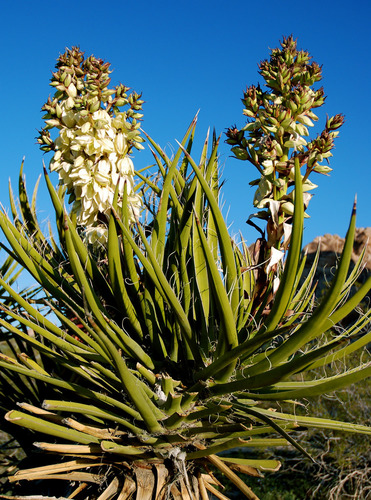


Mojave Yucca
yucca schidigera
The Mojave Yucca (Yucca schidigera) is a signature evergreen shrub or small tree native to the arid desert landscapes of the southwestern United States and northwestern Mexico. Characterized by its dense clusters of sword-like, yellowish-green leaves and rough, fibrous trunk, this resilient plant is a testament to survival in harsh, sun-drenched environments. Indigenous peoples have long revered the Mojave Yucca for its incredible versatility, utilizing its tough leaf fibers for weaving sandals, ropes, and baskets, and its soap-rich roots for shampoo and body wash.
Hábitat: Found in arid desert flats, rocky slopes, and bajadas of the Mojave and Sonoran Deserts, often growing alongside creosote bush and Joshua trees.
The Mojave Yucca is easily identified by its erect, bayonet-like leaves that grow in dense, spiraled rosettes atop a heavy, fibrous trunk. These stiff leaves are yellowish-green, measuring 30 to 150 cm in length, and feature distinct curly white threads (filaments) peeling from their margins. In spring, a massive, club-shaped flower stalk emerges from the center of the rosette, bearing crowded clusters of creamy-white, bell-shaped blossoms that sometimes exhibit a purplish tinge.
Categoría
PlantasRareza
Common
Peligro
1/5 · Muy bajo
Snaps
¡Sé la primera persona en hacer un snap!
The relationship between the yucca plant and the yucca moth is so specialized that neither species can complete its life cycle without the other.
The roots of the Mojave Yucca contain high amounts of natural soap-like compounds called saponins, which were historically used by Native Americans as a shampoo and body wash.
Today, extracts from Yucca schidigera are commonly added to commercial dog and cat foods because they help reduce the odor of the animals' waste.
Utilizes Crassulacean Acid Metabolism to open its stomata only at night, capturing carbon dioxide while drastically reducing water loss during scorching desert days.
Accumulates high concentrations of saponins in its roots and bark, which act as a powerful chemical deterrent against herbivores and insect pests.
Features deeply channeled, concave leaves that act as natural funnels, directing every drop of rare precipitation straight down to its shallow root system.
The Mojave Yucca manufactures its own organic compounds using sunlight, water, carbon dioxide, and essential mineral nutrients absorbed from the desert soil.
Tegeticula yuccasella
The Mojave Yucca has an obligate mutualistic relationship with this insect, which is the sole pollinator of its flowers, while the larvae feed on a portion of the developing yucca seeds.
Neotoma lepida
Desert woodrats feed on the succulent leaves of the Mojave Yucca for moisture and cut the sharp leaves to build defensive fortresses around their nests.
Aún no hay insignias de rasgos asignadas a este objeto.
Todavía no hay alias listados.
Las colecciones para este objeto aparecerán aquí a medida que se añadan más temas.
Peligro
1/5 · Muy bajo
Todavía no hay notas especiales de seguridad.
La forma más fácil de identificar a Mojave Yucca es usar la aplicación de identificación de naturaleza Snappit.
100-500 cm
10-150 kg
50-200 años
The Mojave Yucca manufactures its own organic compounds using sunlight, water, carbon dioxide, and essential mineral nutrients absorbed from the desert soil.
Found in arid desert flats, rocky slopes, and bajadas of the Mojave and Sonoran Deserts, often growing alongside creosote bush and Joshua trees.
Acércate para separar los grupos y explorar dónde se ha fotografiado este objeto.
Los snaps recientes aparecerán aquí a medida que se añadan nuevas observaciones.

California, US
Puedes ver Western Joshua Tree y Engelmann's Hedgehog Cactus.
Ver guía →

Nevada, US
Puedes ver Engelmann's Hedgehog Cactus.
Ver guía →

California, US
Puedes ver Western Joshua Tree y Cactus De Copa De Vino.
Ver guía →















