
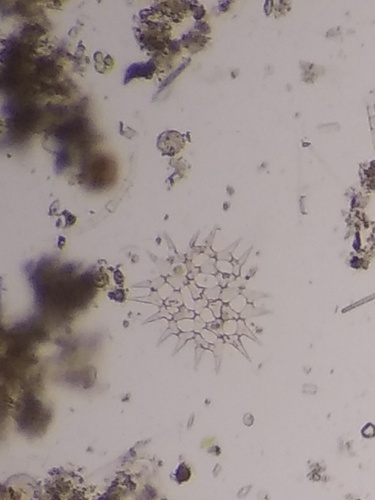


Monactinus Biwae
monactinus biwae
Monactinus Biwae es una hermosa alga verde microscópica, reconocida por su llamativa simetría geométrica en forma de estrella. Operando como un organismo colonial de flotación libre, consiste en un disco de células de una sola capa dispuestas con precisión en anillos concéntricos. Esta microalga juega un papel vital en las redes tróficas de agua dulce, sirviendo como productor primario que convierte la energía solar en materia orgánica mientras oxigena su ambiente acuático.
Hábitat: Habita las aguas abiertas de lagos de agua dulce, embalses y ríos de corriente lenta, prosperando como componente del fitoplancton flotante.
Bajo el microscopio, Monactinus Biwae se asemeja a una estructura verde con forma de rueda o engranaje. Forma colonias planas, en forma de disco (cenobios) que típicamente consisten en 8, 16, 32 o 64 células. Las células internas son poligales y encajan perfectamente, mientras que cada célula externa se caracteriza por un cuerno o espina prominente y único que apunta hacia afuera, lo que le da a toda la colonia una apariencia de explosión estelar. Las células son ricas en clorofila verde, lo que les confiere una coloración verde hierba vibrante.
Categoría
PlantasRareza
Común
Peligro
1/5 · Muy bajo
Snaps
¡Sé la primera persona en hacer un snap!
Recibe su nombre del lago Biwa en Japón, el lago de agua dulce más grande del país, donde fue estudiado históricamente en detalle.
Sus células externas presentan una única proyección en forma de cuerno, lo que distingue al género Monactinus de su pariente cercano Pediastrum, que típicamente tiene dos.
El número de células en una colonia se determina al nacer y no aumenta; las células individuales simplemente crecen a medida que la colonia madura.
La estructura de disco plano y de una sola capa maximiza la exposición de la superficie a la luz solar, optimizando la eficiencia de su proceso fotosintético.
Durante la reproducción, los zoosporas móviles se agrupan dentro de una vesícula temporal y se alinean espontáneamente en una colonia geométrica perfecta antes de desarrollar paredes celulares.
La pared celular contiene biopolímeros robustos y resistentes a la descomposición que protegen la colonia de cambios osmóticos repentinos y daños físicos.
Como organismo fotosintético, fabrica su propio alimento utilizando luz solar, dióxido de carbono y nutrientes inorgánicos disueltos del agua.
Daphnia pulex
Sirve como una fuente vital de nutrición para el zooplancton que se alimenta por filtración.
Microcystis aeruginosa
Compiten por el fósforo y nitrógeno disueltos en lagos de agua dulce.
Aún no hay insignias de rasgos asignadas a este objeto.
Todavía no hay alias listados.
Las colecciones para este objeto aparecerán aquí a medida que se añadan más temas.
Peligro
1/5 · Muy bajo
Todavía no hay notas especiales de seguridad.
Empieza por la planta entera y luego compara la disposición de las hojas, sus bordes, los tallos y las flores o frutos, si los hay. Las hojas opuestas crecen en parejas; las alternas salen de una en una a lo largo del tallo. Juntos, estos detalles dicen mucho más que una sola hoja verde. Identificador de plantas: sube una foto y compara los detalles visibles.
0 cm
Como organismo fotosintético, fabrica su propio alimento utilizando luz solar, dióxido de carbono y nutrientes inorgánicos disueltos del agua.
Habita las aguas abiertas de lagos de agua dulce, embalses y ríos de corriente lenta, prosperando como componente del fitoplancton flotante.
Fotosíntesis
8-64
Acércate para separar los grupos y explorar dónde se ha fotografiado este objeto.
Los snaps recientes aparecerán aquí a medida que se añadan nuevas observaciones.
Llévate el descubrimiento
Haz una foto con Snappit, identifica la especie y guarda el hallazgo en tu colección.

















