
_Buenos_Aires.jpg&width=800)





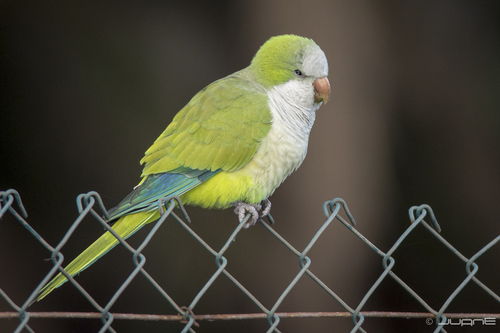
Monk Parakeet
Myiopsitta monachus
Monk Parakeets are cheerful green birds that love to chatter and play. They build big nests in trees and are often seen in flocks, making them a fun sight in parks and gardens.
Hábitat: Urban areas
The Monk Parakeet has a distinctive gray head and chest, contrasting sharply with its bright green body and wings. Its primary flight feathers display a beautiful blue tint, and it possesses a short, pointed tail. This unique combination of gray and green makes it stand out.
Categoría
AvesRareza
Common
Peligro
1/5 · Muy bajo
Snaps
¡Sé la primera persona en hacer un snap!
A single Monk Parakeet nest can be as big as a small car and weigh several hundred pounds!
Monk Parakeets are the only parrot species that build large stick nests instead of nesting in tree holes!
Monk Parakeets can live for over 20 years, even in the wild, which is super long for a bird!
These clever birds often choose city parks, power poles, and buildings as places to call home.
Monk Parakeets can construct massive, multi-chambered stick nests that allow many families to live together for protection and warmth.
Monk Parakeets have a versatile diet and can adjust to various food sources, helping them thrive in diverse environments, including cities.
Monk Parakeets have complex vocal cords that help them imitate a wide range of sounds, including human words and phrases.
Monk Parakeets can endure surprisingly cold climates because their communal nests provide excellent insulation and shelter.
A generalist feeder, they enjoy seeds, fruits, flowers, and even some insects.
Diferencias por edad: Young birds are fed regurgitated food by their parents, gradually transitioning to solid adult foods.
Falco peregrinus
A swift aerial predator of adult parakeets.
Buteo jamaicensis
This common hawk preys on both adults and fledglings.
Zea mays
Feeds on corn kernels, often raiding crops.

Helianthus annuus
Eats the seeds of this tall flowering plant.
Describe a los animales, principalmente aves, que poseen una cubierta de plumas.
Los animales sociales viven en grupos organizados, cooperando para obtener beneficios de supervivencia como la búsqueda de alimento, la defensa y la cría de descendencia.
Los animales cantores producen vocalizaciones complejas, a menudo con el propósito de atraer parejas, defender el territorio o comunicarse dentro de su especie.
Colorido describe a organismos u objetos que exhiben una amplia variedad de colores brillantes y distintivos.

Este rasgo caracteriza a los organismos cuya dieta consiste total o principalmente en material vegetal.

Los animales diurnos están activos principalmente durante el día y suelen descansar o dormir por la noche.

Esta característica de hábitat indica especies que pueden coexistir con los humanos en entornos urbanos y suburbanos, utilizando estructuras artificiales y espacios verdes.

Describe organismos que transfieren polen, permitiendo la fertilización y reproducción de las plantas.
Peligro
1/5 · Muy bajo
Enjoy watching birds from a distance and don't try to touch or catch them.
28-30 cm
48-52 cm
0.1-0.14 kg
15-20 años
55 km/h
A generalist feeder, they enjoy seeds, fruits, flowers, and even some insects.
Urban areas
Foraging
Acércate para separar los grupos y explorar dónde se ha fotografiado este objeto.
Los snaps recientes aparecerán aquí a medida que se añadan nuevas observaciones.

New York, US
Puedes ver León Africano, Tigre y Leopardo De Las Nieves.
Ver guía →

New York, US
Puedes ver Common Dandelion, Red Deadnettle y Broad-Leaved Dock.
Ver guía →

New York, US
Puedes ver Common Mugwort, Snow Goose × Brant y Spotted Lanternfly.
Ver guía →
Florida, US
Puedes ver Monk Parakeet, Peters's Rock Agama y Pelícano Pardo.
Ver guía →
Spain, ES
Puedes ver Vestal, Eurasian Collared-Dove y Mirlo Común.
Ver guía →








.jpg&width=800)





