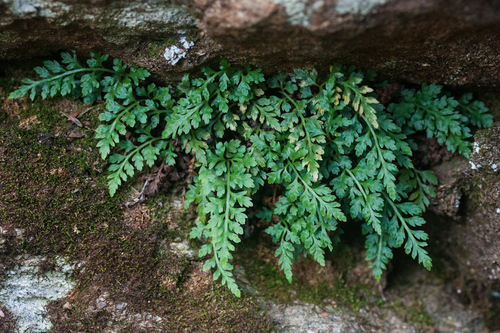


Mountain Spleenwort
asplenium montanum
The Mountain Spleenwort (Asplenium montanum) is a resilient, petite evergreen fern that makes its home in the rugged, acidic rock crevices of the Appalachian region. Clinging tenaciously to sheer sandstone cliffs and shaded ledges, this delicate pteridophyte is a classic lithophyte. Despite its fragile appearance, it is remarkably adapted to survive in nutrient-poor, rocky crevices where few other plants can establish a foothold. This fern is highly regarded by botanists as a key element of cliff-face ecosystems. It often hybridizes with other spleenworts, contributing to a complex evolutionary web of ferns in eastern North America. Its presence is an indicator of pristine, stable microclimates within mountainous forests, making it a delightful find for hikers and botanical enthusiasts alike.
Hábitat: Found in damp, shaded, highly acidic rock crevices and sandstone cliff faces within mountainous forests.
Mountain Spleenwort is a small, tufted fern with bluish-green, triangular to lance-shaped fronds that measure between 5 and 20 centimeters in length. The leaves are deeply divided, giving them a delicate, feathery texture with wedge-shaped segments. A key identification feature is the petiole, which is dark reddish-brown at the very base but transitions into a bright green color as it ascends towards the leafy blade. Its undersides bear linear, brown spore-producing structures called sori arranged in a herring-bone pattern along the veins, which are covered by a thin, pale membrane called an indusium when young.
Categoría
PlantasRareza
Common
Peligro
1/5 · Muy bajo
Snaps
¡Sé la primera persona en hacer un snap!
Mountain Spleenwort is an evolutionary parent to several other hybrid fern species through chromosome doubling, acting as a crucial genetic building block in the Appalachian spleenwort complex.
The common name 'spleenwort' originates from the ancient 'Doctrine of Signatures', which suggested that the spleen-shaped sori on the backs of the fronds could cure ailments of the spleen.
Unlike many ferns that require rich, organic soil, this species is a strict lithophyte, meaning it grows directly on rocks and survives off minimal windblown dust and decomposing organic matter.
It selectively grows in highly acidic, nutrient-deficient rock fissures, utilizing specialized roots to anchor itself and absorb trace minerals.
Can withstand periods of low moisture by curling its fronds to reduce water loss, recovering quickly when humidity returns.
Readily hybridizes with other spleenwort species to produce unique, sterile or fertile hybrid offspring.
As a photoautotrophic plant, it produces its own food through photosynthesis using sunlight, carbon dioxide, water, and essential minerals absorbed from rock crevices.
Asplenium platyneuron
Hybridizes with this species to produce the sterile or fertile allotetraploid hybrids like Lobed Spleenwort.
Bryoxiphium norvegicum
Competes for space and moisture within narrow, humid sandstone crevices in cliff ecosystems.
Aún no hay insignias de rasgos asignadas a este objeto.
Todavía no hay alias listados.
Las colecciones para este objeto aparecerán aquí a medida que se añadan más temas.
Peligro
1/5 · Muy bajo
Todavía no hay notas especiales de seguridad.
La forma más fácil de identificar a Mountain Spleenwort es usar la aplicación de identificación de naturaleza Snappit.
5-20 cm
5-15 años
As a photoautotrophic plant, it produces its own food through photosynthesis using sunlight, carbon dioxide, water, and essential minerals absorbed from rock crevices.
Found in damp, shaded, highly acidic rock crevices and sandstone cliff faces within mountainous forests.
Acércate para separar los grupos y explorar dónde se ha fotografiado este objeto.
Los snaps recientes aparecerán aquí a medida que se añadan nuevas observaciones.




.jpg&width=800)